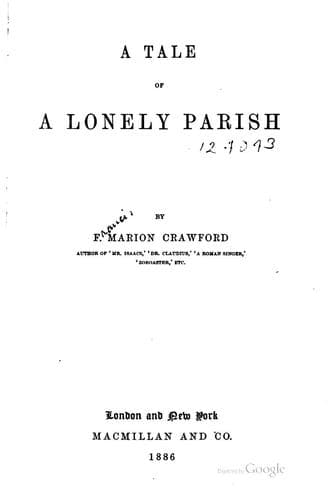
A Tale of a Lonely ParishCrawford, F. Marion (Francis Marion)
General
A Tale of a Lonely Parish
Crawford, F. Marion (Francis Marion)
Country life -- England -- Fiction; England -- Social life and customs -- Fiction
"Yes," she said gently, "it is like old times. Try and think that it is
the old house at Putney, Walter. Do you hear the sparrows chirping, just
as they used to do? The curtains are the same colour, too. You used to
sleep so quietly at the old house. Try and sleep now. Then you will
soon get well. Now, I will sit beside you, but I will not talk any
more--there--are you quite comfortable? A little higher? Yes--so. Go to
sleep."
Her quiet voice soothed him, and her gentle hands made his rest more
easy. She sat down beside him, thinking from his silence that he would
really go to sleep; hoping and yet not hoping, revolving in her mind the
chances of his escape, so soon as he should be strong enough to attempt
it, shuddering at the thought of what his fate must be if he again fell
into the hands of the police. She did not know that a detective was at
that moment in the house, determined to carry her husband away so soon as
the doctor pronounced it possible. Nothing indeed, not even that
knowledge could have added much to the burden of her sorrows as she sat
there, a small and graceful figure with a sad pathetic face, leaning
forward as she sat and gazing drearily at the carpet, where the sunlight
crept in beneath the curtains from the bright world without. It seemed to
her that the turning point in her existence had come, and that this day
must decide all; yet she could not see how it was to be decided, think of
it as she might. One thing stood prominent in her thoughts, and she
delighted to think of it--the generosity of Charles Juxon. From first to
last, from the day when she had frankly told him her story and he had
accepted it and refused to let it bring any difference to his friendship
for her, down to this present time, when after being basely attacked by
her own husband, he had nobly brought the wretch home and was caring
for him as for one of his own blood--through all and in spite of all, the
squire had shown the same unassuming but unfailing generosity. She asked
herself, as she sat beside the sick man, whether there were many like
Charles Juxon in the world. There was the vicar, but the case was very
different. He too had been kind and generous from the first; but he had
not asked her to marry him--she blushed at the thought--he had not loved
her. If Charles Juxon loved her, his generosity to Goddard was all the
greater.
Public-domain text, read in full here on John Shaqi.
Reviews
Reviews
No reviews yet
Be the first to share your thoughts on this work.
Elsewhere in the archive
Join the Discussion
Join the discussion
Sign in to leave a comment or review.
Sign InorCreate an account