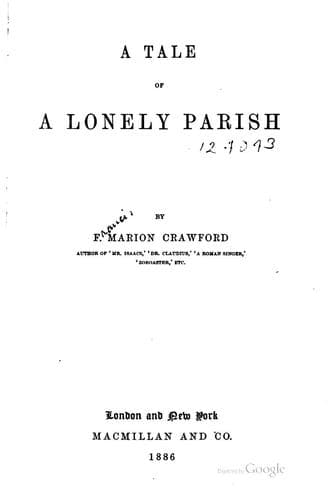
A Tale of a Lonely ParishCrawford, F. Marion (Francis Marion)
General
A Tale of a Lonely Parish
Crawford, F. Marion (Francis Marion)
Country life -- England -- Fiction; England -- Social life and customs -- Fiction
John did not sleep so peacefully nor dream so happily that night as on
the night before. The course of true love had not run smooth that
afternoon. The squire had insisted upon having his share of the lovely
Mrs. Goddard's society and she herself had not seemed greatly disturbed
at a temporary separation from John. The latter amused her for a little
while; the former held the position of a friend whose conversation she
liked better than that of other people. John was disappointed and thought
of going back to Cambridge the next day. So strong, indeed, was his
sudden desire to leave Billingsfield without finishing his visit, that
before going to bed he had packed some of his belongings into his small
portmanteau; the tears almost stood in his eyes as he busied himself
about his room and he muttered certain formulae of self-accusation as he
collected his things, saying over and over in his heart--"What a fool I
am! Why should she care for me? What am I that she should care for me?"
etc. etc. Then he opened his window and looked at the bright stars which
shone out over the old yew tree; but it was exceedingly cold, and so he
shut it again and went to bed, feeling very uncomfortable and unhappy.
But when he awoke in the morning he looked at his half-packed portmanteau
and laughed, and instead of saying "What a fool I am!" he said "What a
fool I was!"--which is generally and in most conditions of human affairs
a much wiser thing to say. Then he carefully took everything out of the
portmanteau again and replaced things as they had lain before in his
room, lest perchance Susan, the housemaid, should detect what had passed
through his mind on the previous evening and should tell Mrs. Ambrose.
And from all this it appears that John was exceedingly young, as indeed
he was, in spite of his being nearly one and twenty years of age. But
doubtless if men were willing to confess their disappointments and
foolish, impetuous resolutions, many would be found who have done
likewise, being in years much older than John Short. Unfortunately for
human nature most men would rather confess to positive wrong-doing than
to any such youthful follies as these, while they are young; and when
they are old they would rather be thought young and foolish than confess
the evil deeds they have actually done.
Public-domain text, read in full here on John Shaqi.
Reviews
Reviews
No reviews yet
Be the first to share your thoughts on this work.
Elsewhere in the archive
Join the Discussion
Join the discussion
Sign in to leave a comment or review.
Sign InorCreate an account