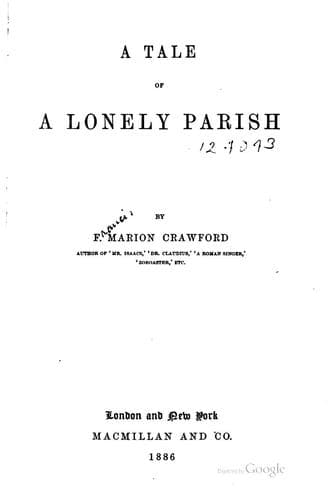
A Tale of a Lonely ParishCrawford, F. Marion (Francis Marion)
General
A Tale of a Lonely Parish
Crawford, F. Marion (Francis Marion)
Country life -- England -- Fiction; England -- Social life and customs -- Fiction
"Oh, of all things. I do not think I have ever heard Greek."
John cleared his throat and began, glancing at his hostess rather
nervously from time to time. But his memory never failed him, and he went
on to the end without a break or hesitation.
"How do you think it sounds?" he asked timidly when he had finished.
"It sounds very funny," said Mrs. Goddard. "I had no idea Greek sounded
like that--but it has a pleasant rhythm."
"That is the thing," said John, enthusiastically. "I see you really
appreciate it. Of course nobody knows how the ancients pronounced Greek,
and if one pronounced it as the moderns do, it would sound all wrong--but
the rhythm is the thing, you know. It is impossible to get over that."
Mrs. Goddard was not positively sure what he meant by "getting over the
rhythm;" possibly John himself could not have defined his meaning very
clearly. But his cheeks glowed and he was very much pleased.
"Yes, of course," said Mrs. Goddard confidently. "But what does it all
mean, Mr. Short?"
"Would you really like to know?" asked John in fresh embarrassment. He
suddenly realised how wonderfully delightful it was to be repeating his
own poetry to the woman for whom it was written.
"Indeed yes--what is the use of your telling me all sorts of things in
Greek, if you do not tell me what they mean?"
"Yes--you will promise not to be offended?"
"Of course," said Mrs. Goddard; then blushing a little she added, "it is
quite--I mean--quite the sort of thing, is not it?"
"Oh quite," said John, blushing too, but looking grave for a moment. Then
he repeated the English translation of the verses which, as they were
certainly not so good as the original, may be omitted here. They set
forth that in the vault of the world's night a new star had appeared
which men had not yet named, nor would be likely to name until the power
of human speech should be considerably increased, and the verses dwelt
upon the theme, turning it and revolving it in several ways, finally
declaring that the far-darting sun must look out for his interests unless
he meant to be outshone by the new star. Translated into English there
was nothing very remarkable about the performance though the original
Greek ode was undoubtedly very good of its kind. But Mrs. Goddard was
determined to be pleased.
"I think it is charming," she said, when John had reached the end and
paused for her criticism.
"The Greek is very much better," said John doubtfully. "I cannot write
English verses--they seem to me so much harder."
"I daresay," said Mrs. Goddard. "But did you really write that
when--" she stopped not knowing exactly how to express herself. But
John had his answer ready.
"Oh, I wrote ever so many," he said, "and I have got them all at
Cambridge. But that is the only one I quite remember. I wrote them just
after the day when I waked up Muggins--the only time I had seen you till
now. I think I could--"
Public-domain text, read in full here on John Shaqi.
Reviews
Reviews
No reviews yet
Be the first to share your thoughts on this work.
Elsewhere in the archive
Join the Discussion
Join the discussion
Sign in to leave a comment or review.
Sign InorCreate an account