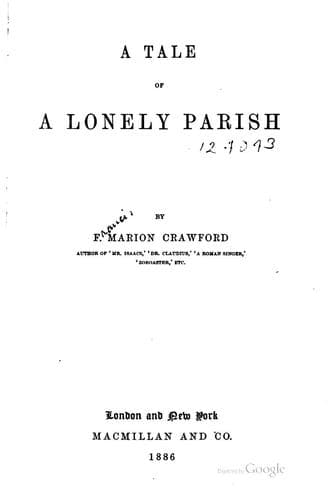
A Tale of a Lonely ParishCrawford, F. Marion (Francis Marion)
General
A Tale of a Lonely Parish
Crawford, F. Marion (Francis Marion)
Country life -- England -- Fiction; England -- Social life and customs -- Fiction
"Oh yes--everywhere," answered the squire with equal indefiniteness. "By
the bye, talking of travelling, when is our young friend going away?"
There was not a shade of ill-humour in the question.
"The day after New Year's--I believe."
"He has had a very pleasant visit."
"Yes," replied Mrs. Goddard, "I hope it will do him a great deal of
good."
"Why? Was he ill? Ah--I remember, they said he had worked too hard. It is
a great mistake to work too hard, especially when one is very young."
"He is very young, is not he?" remarked Mrs. Goddard with a faint smile,
remembering the many conversations she had had with him.
"Very. Did it ever strike you that--well, that he was losing his head a
little?"
"No," answered his companion innocently. "What about?"
"Oh, nothing. Only he has rather a peculiar temper. He is perpetually
getting very angry with no ostensible reason--and then he glares at one
like an angry cat."
"Take care," said Mrs. Goddard, "he might hear you."
"Do him good," said the squire cheerfully.
"Oh, no! It would hurt his feelings dreadfully. How can you be so
unkind?"
"He is a very good boy, you know. Really, I believe he is. Only he is
inclined to be rather too unreasonable; I should think he might be
satisfied."
"Satisfied with what?" inquired Mrs. Goddard, who did not wish to
understand.
"With the way you have treated him," returned the squire bluntly. "You
have been wonderfully good to him."
"Have I?" The faint colour rose to her cheek. "I don't know--poor fellow!
I daresay his life at Cambridge is very dull."
"Yes. Entirely devoid of that species of amusement which he has enjoyed
so abundantly in Billingsfield. It is not every undergraduate who has a
chance to talk to you for a week at a time."
Mr. Juxon made the remark very calmly, without seeming to be in the least
annoyed. He was much too wise a man to appear to be displeased at Mrs.
Goddard's treatment of John. Moreover, he felt that on the present
occasion, at least, John had been summarily worsted; it was his turn to
be magnanimous.
"If you are going to make compliments, I will go away," said Mrs.
Goddard.
"I? I never made a compliment in my life," replied the squire
complacently. "Do you think it is a compliment to tell you that Mr. Short
probably enjoys your conversation much more than the study of Greek
roots?"
"Well--not exactly--"
"Besides, in general," continued the squire, "compliments are mere waste
of breath. If a woman has any vanity she knows her own good points much
better than any man who attempts to explain them to her; and if she has
no vanity, no amount of explanation of her merits will make her see them
in a proper light."
"That is very true," answered Mrs. Goddard, thoughtfully. "It never
struck me before. I wonder whether that is the reason women always like
men who never make any compliments at all?"
The squire's face assumed an amusing expression of inquiry and surprise.
"Is that personal?" he asked.
Public-domain text, read in full here on John Shaqi.
Reviews
Reviews
No reviews yet
Be the first to share your thoughts on this work.
Elsewhere in the archive
Join the Discussion
Join the discussion
Sign in to leave a comment or review.
Sign InorCreate an account