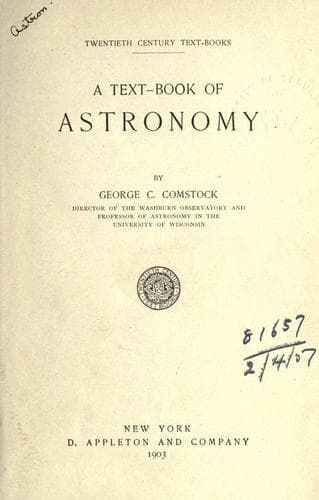
A Text-Book of AstronomyComstock, George C. (George Cary)
Science
A Text-Book of Astronomy
Comstock, George C. (George Cary)
Astronomy
The cubic yard of rock, which upon the earth weighs two tons, would, if
transported to the moon, weigh only one third of a ton, and would have
only one sixth as much influence in compressing the rocks below it as it
had upon the earth. Note that this rock when transported to the moon
would be still attracted by the earth and would have weight toward the
earth, but it is not this of which we are speaking; by its weight in
the moon we mean the force with which the moon attracts it. Making due
allowance for the difference in compression produced by weight, we may
say that in general, so far as density goes, the moon is very like a
piece of the earth of equal mass set off by itself alone.
97. ALBEDO.--In another respect the lunar stuff is like that of which
the earth is made: it reflects the sunlight in much the same way and to
the same amount. The contrast of light and dark areas on the moon's
surface shows, as we shall see in another section, the presence of
different substances upon the moon which reflect the sunlight in
different degrees. This capacity for reflecting a greater or less
percentage of the incident sunlight is called _albedo_ (Latin,
whiteness), and the brilliancy of the full moon might lead one to
suppose that its albedo is very great, like that of snow or those masses
of summer cloud which we call thunderheads. But this is only an effect
of contrast with the dark background of the sky. The same moon by day
looks pale, and its albedo is, in fact, not very different from that of
our common rocks--weather-beaten sandstone according to Sir John
Herschel--so that it would be possible to build an artificial moon of
rock or brick which would shine in the sunlight much as does the real
moon.
The effect produced by the differences of albedo upon the moon's face is
commonly called the "man in the moon," but, like the images presented by
glowing coals, the face in the moon is anything which we choose to make
it. Among the Chinese it is said to be a monkey pounding rice; in India,
a rabbit; in Persia, the earth reflected as in a mirror, etc.
Public-domain text, read in full here on John Shaqi.
Reviews
Reviews
No reviews yet
Be the first to share your thoughts on this work.
Elsewhere in the archive
Join the Discussion
Join the discussion
Sign in to leave a comment or review.
Sign InorCreate an account