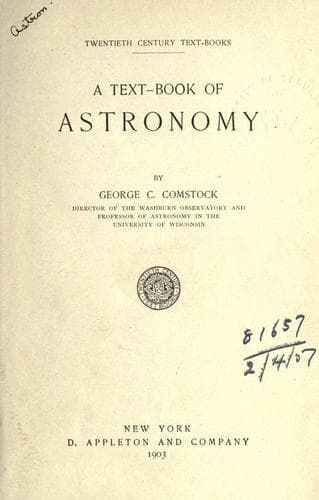
A Text-Book of AstronomyComstock, George C. (George Cary)
Science
A Text-Book of Astronomy
Comstock, George C. (George Cary)
Astronomy
109. THE MOON'S INFLUENCE UPON THE EARTH.--There is a widespread popular
belief that in many ways the moon exercises a considerable influence
upon terrestrial affairs: that it affects the weather for good or ill,
that crops must be planted and harvested, pigs must be killed, and
timber cut at the right time of the moon, etc. Our common word lunatic
means moonstruck--i. e., one upon whom the moon has shone while
sleeping. There is not the slightest scientific basis for any of these
beliefs, and astronomers everywhere class them with tales of witchcraft,
magic, and popular delusion. For the most part the moon's influence upon
the earth is limited to the light which it sends and the effect of its
gravitation, chiefly exhibited in the ocean tides. We receive from the
moon a very small amount of second-hand solar heat and there is also a
trifling magnetic influence, but neither of these last effects comes
within the range of ordinary observation, and we shall not go far wrong
in saying that, save the moonlight and the tides, every supposed lunar
influence upon the earth is either fictitious or too small to be readily
detected.
CHAPTER X
THE SUN
110. DEPENDENCE OF THE EARTH UPON THE SUN.--There is no better
introduction to the study of the sun than Byron's Ode to Darkness,
beginning with the lines--
"I dreamed a dream
That was not all a dream.
The bright sun was extinguished,"
and proceeding to depict in vivid words the consequences of this
extinction. The most matter-of-fact language of science agrees with the
words of the poet in declaring the earth's dependence upon the sun for
all those varied forms of energy which make it a fit abode for living
beings. The winds blow and the rivers run; the crops grow, are gathered
and consumed, by virtue of the solar energy. Factory, locomotive, beast,
bird, and the human body furnish types of machines run by energy derived
from the sun; and the student will find it an instructive exercise to
search for kinds of terrestrial energy which are not derived either
directly or indirectly from the sun. There are a few such, but they are
neither numerous nor important.
Public-domain text, read in full here on John Shaqi.
Reviews
Reviews
No reviews yet
Be the first to share your thoughts on this work.
Elsewhere in the archive
Join the Discussion
Join the discussion
Sign in to leave a comment or review.
Sign InorCreate an account