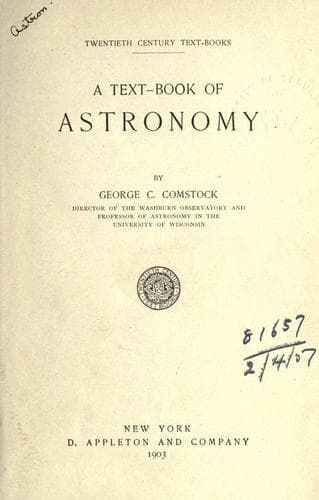
A Text-Book of AstronomyComstock, George C. (George Cary)
Science
A Text-Book of Astronomy
Comstock, George C. (George Cary)
Astronomy
The simple theory that the solar phenomena are caused by an interchange
of hotter and cooler matter between the photosphere and the lower strata
of the sun furnishes in its present shape little or no explanation of
such features as the sun-spot period, the variations in the corona, the
peculiar character of the sun's rotation, etc., and we have still
unsolved in the mechanical theory of the sun one of the noblest problems
of astronomy, and one upon which both observers and theoretical
astronomers are assiduously working at the present time. A close watch
is kept upon sun spots and prominences, the corona is observed at every
total eclipse, and numerous are the ingenious methods which are being
suggested and tried for observing it without an eclipse in ordinary
daylight. Attempts, more or less plausible, have been made and are now
pending to explain photosphere, spots and the reversing layer by means
of the refraction of light within the sun's outer envelope of gases, and
it seems altogether probable, in view of these combined activities, that
a considerable addition to our store of knowledge concerning the sun may
be expected in the not distant future.
CHAPTER XI
THE PLANETS
133. PLANETS.--Circling about the sun, under the influence of his
attraction, is a family of planets each member of which is, like the
moon, a dark body shining by reflected sunlight, and therefore
presenting phases; although only two of them, Mercury and Venus, run
through the complete series--new, first quarter, full, last
quarter--which the moon presents. The way in which their orbits are
grouped about the sun has been considered in Chapter III, and Figs. 16
and 17 of that chapter may be completed so as to represent all of the
planets by drawing in Fig. 16 two circles with radii of 7.9 and 12.4
centimeters respectively, to represent the orbits of the planets Uranus
and Neptune, which are more remote from the sun than Saturn, and by
introducing a little inside the orbit of Jupiter about 500 ellipses of
different sizes, shapes, and positions to represent a group of minor
planets or asteroids as they are often called. It is convenient to
regard these asteroids as composing by themselves a class of very small
planets, while the remaining 8 larger planets fall naturally into two
other classes, a group of medium-sized ones--Mercury, Venus, Earth, and
Mars--called inner planets by reason of their nearness to the sun; and
the outer planets--Jupiter, Saturn, Uranus, Neptune--each of which is
much larger and more massive than any planet of the inner group. Compare
in Figs. 84 and 85 their relative sizes. The earth, _E_, is introduced
into Fig. 85 as a connecting link between the two figures.
Some of these planets, like the earth, are attended by one or more
moons, technically called satellites, which also shine by reflected
sunlight and which move about their respective planets in accordance
with the law of gravitation, much as the moon moves around the earth.
Public-domain text, read in full here on John Shaqi.
Reviews
Reviews
No reviews yet
Be the first to share your thoughts on this work.
Elsewhere in the archive
Join the Discussion
Join the discussion
Sign in to leave a comment or review.
Sign InorCreate an account