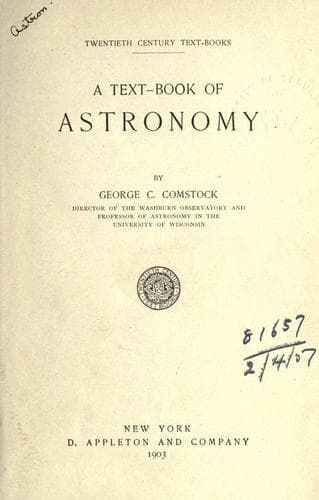
A Text-Book of AstronomyComstock, George C. (George Cary)
Science
A Text-Book of Astronomy
Comstock, George C. (George Cary)
Astronomy
Of the inner planets, Mercury and the moon seem destitute of any
considerable atmospheres, and are therefore lacking in the supply of
water necessary for life, and the same is almost certainly true of all
the asteroids. There remain Venus, Mars, and the satellites of the outer
planets, which latter, however, we must drop from consideration as being
too little known. On Venus there is an atmosphere probably containing
vapor of water, and it is well within the range of possibility that
liquid water should exist upon the surface of this planet and that its
temperature should fall within the prescribed limits. It would, however,
be straining our actual knowledge to affirm that such is the case, or to
insist that if such were the case, life would necessarily exist upon the
planet.
On Mars we encounter the fundamental difficulty of temperature already
noted in § 152. If in some unknown way the temperature is maintained
sufficiently high for the polar caps to be real snow, thawing and
forming again with the progress of the seasons, the necessary conditions
of life would seem to be fulfilled here and life if once introduced upon
the planet might abide and flourish. But of positive proof that such is
the case we have none.
On the whole, our survey lends little encouragement to the belief in
planetary life, for aside from the earth, of all the hundreds of bodies
in the solar system, not one is found in which the necessary conditions
of life are certainly fulfilled, and only two exist in which there is a
reasonable probability that these conditions may be satisfied.
CHAPTER XII
COMETS AND METEORS
158. VISITORS IN THE SOLAR SYSTEM.--All of the objects--sun, moon,
planets, stars--which we have thus far had to consider, are permanent
citizens of the sky, and we have no reason to suppose that their present
appearance differs appreciably from what it was 1,000 years or 10,000
years ago. But there is another class of objects--comets, meteors--which
appear unexpectedly, are visible for a time, and then vanish and are
seen no more. On account of this temporary character the astronomers of
ancient and mediæval times for the most part refused to regard them as
celestial bodies but classed them along with clouds, fogs,
Jack-o'-lanterns, and fireflies, as exhalations from the swamps or the
volcano; admitting them to be indeed important as harbingers of evil to
mankind, but having no especial significance for the astronomer.
The comet of 1618 A. D. inspired the lines--
"Eight things there be a Comet brings,
When it on high doth horrid range:
Wind, Famine, Plague, and Death to Kings,
War, Earthquakes, Floods, and Direful Change,"
which, according to White (History of the Doctrine of Comets), were to
be taught in all seriousness to peasants and school children.
Public-domain text, read in full here on John Shaqi.
Reviews
Reviews
No reviews yet
Be the first to share your thoughts on this work.
Elsewhere in the archive
Join the Discussion
Join the discussion
Sign in to leave a comment or review.
Sign InorCreate an account