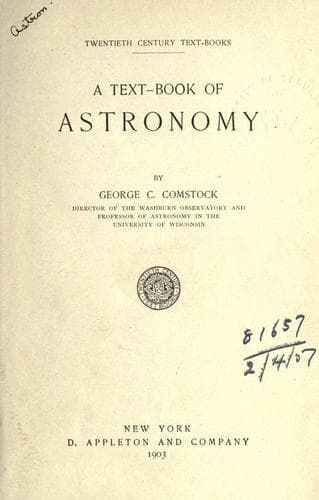
A Text-Book of AstronomyComstock, George C. (George Cary)
Science
A Text-Book of Astronomy
Comstock, George C. (George Cary)
Astronomy
The observed orbits of these five comets present some slight
discordances among themselves, but if we suppose each comet to move in
the average of the observed paths it is a simple matter to fix their
several positions at the present time. They have all receded from the
sun nearly on line toward the bright star Sirius, and were all of them,
at the beginning of the year 1900, standing nearly motionless inside of
a space not bigger than the sun and distant from the sun about 150 radii
of the earth's orbit. The great rapidity with which they swept through
that part of their orbit near the sun (see § 162) is being compensated
by the present extreme slowness of their motions, so that the comets of
1668 and 1882, whose passages through the solar system were separated by
an interval of more than two centuries, now stand together near the
aphelion of their orbits, separated by a distance only 50 per cent
greater than the diameter of the moon's orbit, and they will continue
substantially in this position for some two or three centuries to come.
The slowness with which these bodies move when far from the sun is
strikingly illustrated by an equation of celestial mechanics which for
parabolic orbits takes the place of Kepler's Third Law--viz.:
r^3 / T^2 = 178,
where _T_ is the time, in years, required for the comet to move from its
perihelion to any remote part of the orbit, whose distance from the sun
is represented, in radii of the earth's orbit, by _r_. If the comet of
1668 had moved in a parabola instead of the ellipse supposed above, how
many years would have been required to reach its present distance from
the sun?
178. RELATION OF COMETS TO THE SOLAR SYSTEM.--The orbits of these comets
illustrate a tendency which is becoming ever more strongly marked.
Because comet orbits are nearly parabolas, it used to be assumed that
they were exactly parabolic, and this carried with it the conclusion
that comets have their origin outside the solar system. It may be so,
and this view is in some degree supported by the fact that these nearly
parabolic orbits of both comets and meteors are tipped at all possible
angles to the plane of the ecliptic instead of lying near it as do the
orbits of the planets; and by the further fact that, unlike the planets,
the comets show no marked tendency to move around their orbits in the
direction in which the sun rotates upon his axis. There is, in fact, the
utmost confusion among them in this respect, some going one way and some
another. The law of the solar system (gravitation) is impressed upon
their movements, but its order is not.
Public-domain text, read in full here on John Shaqi.
Reviews
Reviews
No reviews yet
Be the first to share your thoughts on this work.
Elsewhere in the archive
Join the Discussion
Join the discussion
Sign in to leave a comment or review.
Sign InorCreate an account