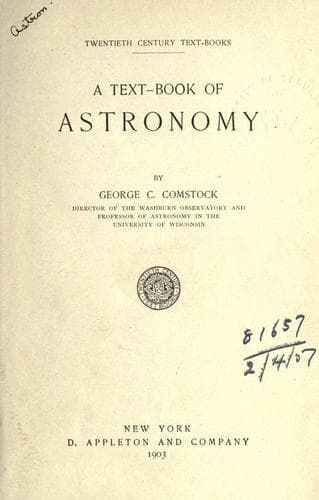
A Text-Book of AstronomyComstock, George C. (George Cary)
Science
A Text-Book of Astronomy
Comstock, George C. (George Cary)
Astronomy
It was long ago suggested that the sun possibly exerts upon a comet's
substance a repelling force in addition to the attracting force which we
call gravity. We think naturally in this connection of the repelling
force which a charge of electricity exerts upon a similar charge placed
on a neighboring body, and we note that if both sun and comet carried a
considerable store of electricity upon their surfaces this would furnish
just such a repelling force as seems indicated by the phenomena of
comets' tails; for the force of gravity would operate between the
substance of sun and comet, and on the whole would be the controlling
force, while the electric charges would produce a repulsion, relatively
feeble for the big particles and strong for the little ones, since an
electric charge lies wholly on the surface, while gravity permeates the
whole mass of a body, and the ratio of volume (gravity) to surface
(electric charge) increases rapidly with increasing size. The repelling
force would thrust back toward the comet those particles which flowed
out toward the sun, while it would urge forward those which flowed away
from it, thus producing the difference in appearance between tail and
envelopes, the latter being regarded from this standpoint as stunted
tails strongly curved backward. In recent years the Russian astronomer
Bredichin has made a careful study of the shape and positions of comets'
tails and finds that they fit with mathematical precision to the
theories of electric repulsion.
Public-domain text, read in full here on John Shaqi.
Reviews
Reviews
No reviews yet
Be the first to share your thoughts on this work.
Elsewhere in the archive
Join the Discussion
Join the discussion
Sign in to leave a comment or review.
Sign InorCreate an account