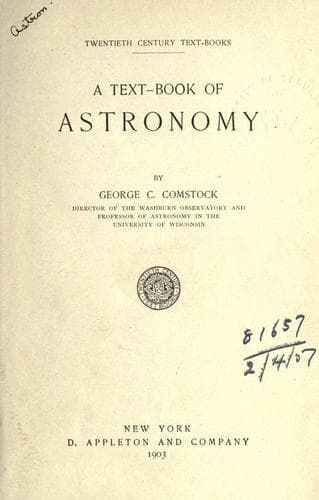
A Text-Book of AstronomyComstock, George C. (George Cary)
Science
A Text-Book of Astronomy
Comstock, George C. (George Cary)
Astronomy
By heating hydrocarbons in our laboratories until they become
incandescent, something like the comet spectrum may be artificially
produced, but the best approximation to it is obtained by passing a
disruptive electrical discharge through a tube in which fragments of
meteors have been placed. A flash of lightning is a disruptive
electrical discharge upon a grand scale. Now, meteors and electric
phenomena have been independently brought to our notice in connection
with comets, and with this suggestion it is easy to frame a general idea
of the physical condition of these objects--for example, a cloud of
meteors of different sizes so loosely clustered that the average density
of the swarm is very low indeed; the several particles in motion
relative to each other, as well as to the sun, and disturbed in that
motion by the sun's tidal action. Each particle carries its own electric
charge, which may be of higher or lower tension than that of its
neighbor, and is ready to leap across the intervening gap whenever two
particles approach each other. To these conditions add the inductive
effect of the sun's electric charge, which tends to produce a particular
and artificial distribution of electricity among the comet's particles,
and we may expect to find an endless succession of sparks, tiny
lightning flashes, springing from one particle to another, most frequent
and most vivid when the comet is near the sun, but never strong enough
to be separately visible. Their number is, however, great enough to make
the comet in part self-luminous with three kinds of light--i. e., the
three bright bands of its spectrum, whose wave lengths show in the comet
the same elements and compounds of the elements--carbon, hydrogen, and
oxygen--which chemical analysis finds in the fallen meteor. It is not to
be supposed that these are the only chemical elements in the comet, as
they certainly are not the only ones in the meteor. They are the easy
ones to detect under ordinary circumstances, but in special cases, like
that of the Great Comet of 1882, whose near approach to the sun rendered
its whole substance incandescent, the spectrum glows with additional
bright lines of sodium, iron, etc.
Public-domain text, read in full here on John Shaqi.
Reviews
Reviews
No reviews yet
Be the first to share your thoughts on this work.
Elsewhere in the archive
Join the Discussion
Join the discussion
Sign in to leave a comment or review.
Sign InorCreate an account