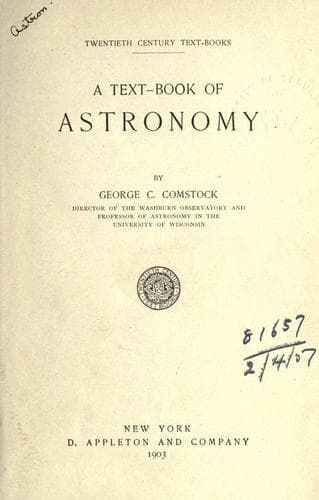
A Text-Book of AstronomyComstock, George C. (George Cary)
Science
A Text-Book of Astronomy
Comstock, George C. (George Cary)
Astronomy
191. PROPER MOTIONS.--It is evident that these stars are too far apart
for their mutual attractions to have much influence one upon another,
and that we have here a case in which, according to § 34, each star is
free to keep unchanged its state of rest or motion with unvarying
velocity along a straight line. Their very name, _fixed stars_, implies
that they are at rest, and so astronomers long believed. Hipparchus (125
B. C.) and Ptolemy (130 A. D.) observed and recorded many allineations
among the stars, in order to give to future generations a means of
settling this very question of a possible motion of the stars and a
resulting change in their relative positions upon the sky. For example,
they found at the beginning of the Christian era that the four stars,
Capella, ε Persei, α and β Arietis, stood in a straight line--i. e.,
upon a great circle of the sky. Verify this by direct reference to the
sky, and see how nearly these stars have kept the same position for
nearly twenty centuries. Three of them may be identified from the star
maps, and the fourth, ε Persei, is a third-magnitude star between
Capella and the other two.
Other allineations given by Ptolemy are: Spica, Arcturus and β Bootis;
Spica, δ Corvi and γ Corvi; α Libræ, Arcturus and ζ Ursæ Majoris.
Arcturus does not now fit very well to these alignments, and nearly two
centuries ago it, together with Aldebaran and Sirius, was on other
grounds suspected to have changed its place in the sky since the days of
Ptolemy. This discovery, long since fully confirmed, gave a great
impetus to observing with all possible accuracy the right ascensions and
declinations of the stars, with a view to finding other cases of what
was called _proper motion_--i. e., a motion peculiar to the individual
star as contrasted with the change of right ascension and declination
produced for all stars by the precession.
Since the middle of the eighteenth century there have been made many
thousands of observations of this kind, whose results have gone into
star charts and star catalogues, and which are now being supplemented by
a photographic survey of the sky that is intended to record permanently
upon photographic plates the position and magnitude of every star in the
heavens down to the fourteenth magnitude, with a view to ultimately
determining all their proper motions.
Public-domain text, read in full here on John Shaqi.
Reviews
Reviews
No reviews yet
Be the first to share your thoughts on this work.
Elsewhere in the archive
Join the Discussion
Join the discussion
Sign in to leave a comment or review.
Sign InorCreate an account