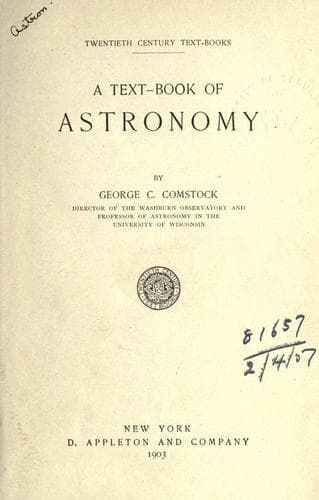
A Text-Book of AstronomyComstock, George C. (George Cary)
Science
A Text-Book of Astronomy
Comstock, George C. (George Cary)
Astronomy
Although the half-dozen stars contained in the table all have orbits of
much the same size and with much the same periodic time as those in
which Uranus and Neptune move, this is by no means true of all the
double stars, many of which have periods running up into the hundreds if
not thousands of years, while a few complete their orbital revolutions
in periods comparable with, or even shorter than, that of Jupiter.
201. DARK STARS.--Procyon, the next to the last star of the preceding
table, calls for some special mention, as the determination of its mass
and orbit stands upon a rather different basis from that of the other
stars. More than half a century ago it was discovered that its proper
motion was not straight and uniform after the fashion of ordinary stars,
but presented a series of loops like those marked out by a bright point
on the rim of a swiftly running bicycle wheel. The hub may move straight
forward with uniform velocity, but the point near the tire goes up and
down, and, while sharing in the forward motion of the hub, runs
sometimes ahead of it, sometimes behind, and such seemed to be the
motion of Procyon and of Sirius as well. Bessel, who discovered it, did
not hesitate to apply the laws of motion, and to affirm that this
visible change of the star's motion pointed to the presence of an unseen
companion, which produced upon the motions of Sirius and Procyon just
such effects as the visible companions produce in the motions of double
stars. A new kind of star, dark instead of bright, was added to the
astronomer's domain, and its discoverer boldly suggested the possible
existence of many more. "That countless stars are visible is clearly no
argument against the existence of as many more invisible ones." "There
is no reason to think radiance a necessary property of celestial
bodies." But most astronomers were incredulous, and it was not until
1862 that, in the testing of a new and powerful telescope just built, a
dark star was brought to light and the companion of Sirius actually
seen. The visual discovery of the dark companion of Procyon is of still
more recent date (November, 1896), when it was detected with the great
telescope of the Lick Observatory. This discovery is so recent that the
orbit is still very uncertain, being based almost wholly upon the
variations in the proper motion of the star, and while the periodic time
must be very nearly correct, the mass of the stars and dimensions of the
orbit may require considerable correction.
The companion of Sirius is about ten magnitudes and that of Procyon
about twelve magnitudes fainter than the star itself. How much more
light does the bright star give than its faint companion? Despite the
tremendous difference of brightness represented by the answer to this
question, the mass of Sirius is only about twice as great as that of its
companion, and for Procyon the ratio does not exceed five or six.
Public-domain text, read in full here on John Shaqi.
Reviews
Reviews
No reviews yet
Be the first to share your thoughts on this work.
Elsewhere in the archive
Join the Discussion
Join the discussion
Sign in to leave a comment or review.
Sign InorCreate an account