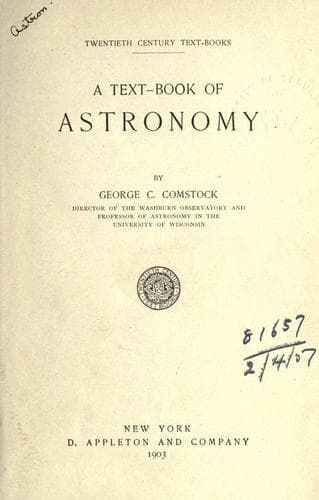
A Text-Book of AstronomyComstock, George C. (George Cary)
Science
A Text-Book of Astronomy
Comstock, George C. (George Cary)
Astronomy
By the aid of powerful photographic apparatus, during the period of its
waning brilliancy a ring of faint nebulous matter was detected
surrounding the star and drifting around and away from it much as if a
series of nebulæ had been thrown off by the star at the time of its
sudden outburst of light. But the extraordinary velocity of this nebular
motion, nearly a billion miles per hour, makes such an explanation
almost incredible, and astronomers are more inclined to believe that the
ring was merely a reflection of the star's own light from a cloud of
meteoric matter, into which a rapidly moving dark star plunged and,
after the fashion of terrestrial meteors, was raised to brilliant
incandescence by the collision. If we assume this to be the true
explanation of these extraordinary phenomena, it is possible to show
from the known velocity with which light travels through space and from
the rate at which the nebula spread, that the distance of Nova Persei,
as the new star is called, corresponds to a parallax of about one
one-hundredth of a second, a result that is, in substance, confirmed by
direct telescopic measurements of its parallax.
Another modern temporary star is Nova Aurigæ, which appeared suddenly in
December, 1891, waned, and in the following April vanished, only to
reappear three months later for another season of renewed brightness.
The spectra of both these modern Novæ contain both dark and bright lines
displaced toward opposite ends of the spectrum, and suggesting the
Doppler effect that would be produced by two or more glowing bodies
having rapid and opposite motions in the line of sight. But the most
recent investigations cast discredit on this explanation and leave the
spectra of temporary stars still a subject of debate among astronomers,
with respect both to the motion they indicate and the intrinsic nature
of the stars themselves. The varying aspect of the spectra suggested at
one time the sun's chromosphere, at another time the conditions that are
present in nebulæ, etc.
CHAPTER XIV
STARS AND NEBULÆ
Public-domain text, read in full here on John Shaqi.
Reviews
Reviews
No reviews yet
Be the first to share your thoughts on this work.
Elsewhere in the archive
Join the Discussion
Join the discussion
Sign in to leave a comment or review.
Sign InorCreate an account