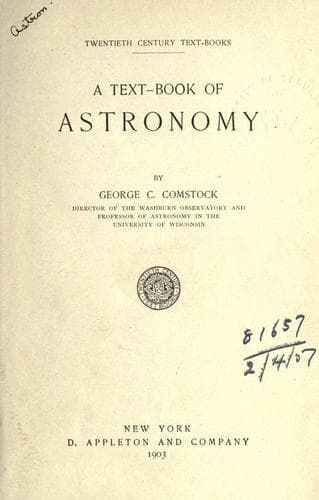
A Text-Book of AstronomyComstock, George C. (George Cary)
Science
A Text-Book of Astronomy
Comstock, George C. (George Cary)
Astronomy
The rate of increase in the number of stars from one magnitude to the
next, as shown in § 187, is proof of another kind of irregularity in
their distribution. It is not difficult to show, mathematically, that if
in distant regions of space the stars were on the average as numerous
and as bright as they are in the regions nearer to the sun, then the
stars of any particular magnitude ought to be four times as numerous as
those of the next brighter magnitude--e. g., four times as many
sixth-magnitude stars as there are fifth-magnitude ones. But, as we have
already seen in § 187, by actual count there are only three times as
many, and from the discrepancy between these numbers, an actual
threefold increase instead of a fourfold one, we must conclude that on
the whole the stars near the sun are either bigger or brighter or more
numerous than in the remoter depths of space.
221. THE STELLAR SYSTEM.--But the arrangement of the stars is not
altogether lawless and chaotic; there are traces of order and system,
and among these the Milky Way is the dominant feature. Telescope and
photographic plate alike show that it is made up of stars which,
although quite irregularly scattered along its course, are on the
average some twenty times as numerous in the galaxy as at its poles,
and which thin out as we recede from it on either side, at first rapidly
and then more slowly. This tendency to cluster along the Milky Way is
much more pronounced among the very faint telescopic stars than among
the brighter ones, for the lucid stars and the telescopic ones down to
the tenth or eleventh magnitude, while very plainly showing the
clustering tendency, are not more than three times as numerous in the
galaxy as in the constellations most remote from it. It is remarkable as
showing the condensation of the brightest stars that one half of all the
stars in the sky which are brighter than the second magnitude are
included within a belt extending 12° on either side of the center line
of the galaxy.
In addition to this general condensation of stars toward the Milky Way,
there are peculiarities in the distribution of certain classes of stars
which are worth attention. Planetary nebulæ and new stars are seldom, if
ever, found far from the Milky Way, and stars with bright lines in their
spectra especially affect this region of the sky. Stars with spectra of
the first type--Sirian stars--are much more strongly condensed toward
the Milky Way than are stars of the solar type, and in consequence of
this the Milky Way is peculiarly rich in light of short wave lengths.
Resolvable star clusters are so much more numerous in the galaxy than
elsewhere, that its course across the sky would be plainly indicated by
their grouping upon a map showing nothing but clusters of this kind.
Public-domain text, read in full here on John Shaqi.
Reviews
Reviews
No reviews yet
Be the first to share your thoughts on this work.
Elsewhere in the archive
Join the Discussion
Join the discussion
Sign in to leave a comment or review.
Sign InorCreate an account