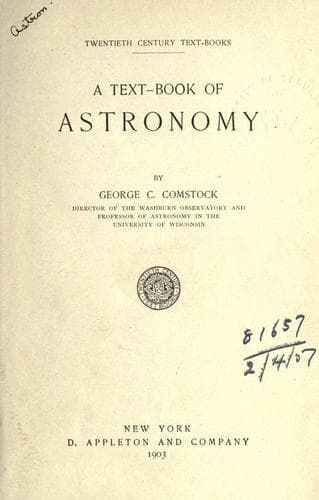
A Text-Book of AstronomyComstock, George C. (George Cary)
Science
A Text-Book of Astronomy
Comstock, George C. (George Cary)
Astronomy
One proposed modification, much discussed in recent years, consists in
substituting for the primitive _gaseous_ nebula imagined by Laplace, a
very diffuse cloud of meteoric matter which in the course of its
development would become transformed into the gaseous state by rising
temperature. From this point of view much of the meteoric dust still
scattered throughout the solar system may be only the fragments left
over in fashioning the sun and planets. Chamberlin and Moulton, who have
recently given much attention to this subject, in dissenting from some
of Laplace's views, consider that the primitive nebulous condition must
have been one in which the matter of the system was "so brought together
as to give low mass, high momentum, and irregular distribution to the
outer part, and high mass, low momentum, and sphericity to the central
part," and they suggest a possible oblique collision of a small nebula
with the outer parts of a large one.
232. BODE'S LAW.--We should not leave the theory of Laplace without
noting the light it casts upon one point otherwise obscure--the meaning
of Bode's law (§ 134). This law, stated in mathematical form, makes a
geometrical series, and similar geometrical series apply to the
distances of the satellites of Jupiter and Saturn from these planets.
Now, Roche has shown by the application of physical laws to the
shrinkage of a gaseous body that its radius at any time may be expressed
by means of a certain mathematical formula very similar to Bode's law,
save that it involves the amount of time that has elapsed since the
beginning of the shrinking process. By comparing this formula with the
one corresponding to Bode's law he reaches the conclusion that the
peculiar spacing of the planets expressed by that law means that they
were formed at successive _equal_ intervals of time--i. e., that Mars is
as much older than the earth as the earth is older than Venus, etc. The
failure of Bode's law in the case of Neptune would then imply that the
interval of time between the formation of Neptune and Uranus was shorter
than that which has prevailed for the other planets. But too much
stress should not be placed upon this conclusion. So long as the manner
in which the planets came into being continues an open question,
conclusions about their time of birth must remain of doubtful validity.
Public-domain text, read in full here on John Shaqi.
Reviews
Reviews
No reviews yet
Be the first to share your thoughts on this work.
Elsewhere in the archive
Join the Discussion
Join the discussion
Sign in to leave a comment or review.
Sign InorCreate an account