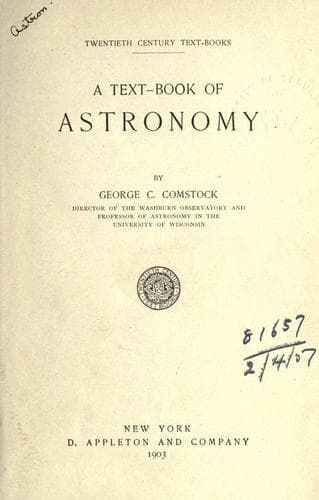
A Text-Book of AstronomyComstock, George C. (George Cary)
Science
A Text-Book of Astronomy
Comstock, George C. (George Cary)
Astronomy
The molecules of a gas are quite independent one of another, and are in
a state of ceaseless agitation, each one darting to and fro, colliding
with its neighbors or with whatever else opposes its forward motion, and
traveling with velocities which, on the average, amount to a good many
hundreds of feet per second, although in the case of any individual
molecule they may be much less or much greater than the average value,
an occasional molecule having possibly a velocity several times as great
as the average. In the upper regions of our own atmosphere, if one of
these swiftly moving particles of oxygen or nitrogen were headed away
from the earth with a velocity of seven miles per second, the whole
attractive power of the earth would be insufficient to check its motion,
and it would therefore, unless stopped by some collision, escape from
the earth and return no more. But, since this velocity of seven miles
per second is more than thirty times as great as the average velocity of
the molecules of air, it must be very seldom indeed that one is found to
move so swiftly, and the loss of the earth's atmosphere by leakage of
this sort is insignificant. But upon the moon, or any other body where
the force of gravity is small, conditions are quite different, and in
our satellite a velocity of little more than one mile per second would
suffice to carry a molecule away from the outer limits of its
atmosphere. This velocity, only five times the average, would be
frequently attained, particularly in former times when the moon's
temperature was high, for then the average velocity of all the molecules
would be considerably increased, and the amount of leakage might become,
and probably would become, a serious matter, steadily depleting the
moon's atmosphere and leading finally to its present state of
exhaustion. It is possible that the moon may at one time have had an
atmosphere, but if so it could have been only a temporary possession,
and the same line of reasoning may be applied to the asteroids and to
most of the satellites of the solar system, and also, though in less
degree, to the smaller planets, Mercury and Mars.
Public-domain text, read in full here on John Shaqi.
Reviews
Reviews
No reviews yet
Be the first to share your thoughts on this work.
Elsewhere in the archive
Join the Discussion
Join the discussion
Sign in to leave a comment or review.
Sign InorCreate an account