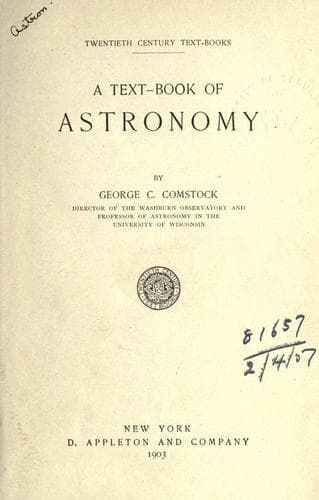
A Text-Book of AstronomyComstock, George C. (George Cary)
Science
A Text-Book of Astronomy
Comstock, George C. (George Cary)
Astronomy
In his theory of tidal friction, Darwin has pointed out that whenever
the periodic time in the orbit is more than twice as long as the time
required for rotation about the axis, the effect of the tides is to
increase the eccentricity of the orbit, and, following this indication,
See has urged that with increasing distance between the components of a
double star their orbits about the common center of gravity must grow
more and more eccentric, so that we have in the shape of such orbits a
new index of stellar development; the more eccentric the orbit, the
farther advanced are the stars. It is important to note in this
connection that among the double stars whose orbits have been computed
there seems to run a general rule--the larger the orbit the greater is
its eccentricity--a relation which must hold true if tidal friction
operates as above supposed, and which, being found to hold true,
confirms in some degree the criteria of stellar age which are furnished
by the theory of tidal friction.
245. NEBULÆ.--The nebular hypothesis of Laplace has inclined astronomers
to look upon nebulæ in general as material destined to be worked up into
stars, but which is now in a very crude and undeveloped stage. Their
great bulk and small density seem also to indicate that gravitation has
not yet produced in them results at all comparable with what we see in
sun and stars. But even among nebulæ there are to be found very
different stages of development. The irregular nebula, shapeless and
void like that of Orion; the spiral, ring, and planetary nebulæ and the
star cluster, clearly differ in amount of progress toward their final
goal. But it is by no means sure that these several types are different
stages in one line of development; for example, the primitive nebula
which grows into a spiral may never become a ring or planetary nebula,
and _vice versa_. So too there is no reason to suppose that a star
cluster will ever break up into isolated stars such as those whose
relation to each other is shown in Fig. 122.
Public-domain text, read in full here on John Shaqi.
Reviews
Reviews
No reviews yet
Be the first to share your thoughts on this work.
Elsewhere in the archive
Join the Discussion
Join the discussion
Sign in to leave a comment or review.
Sign InorCreate an account