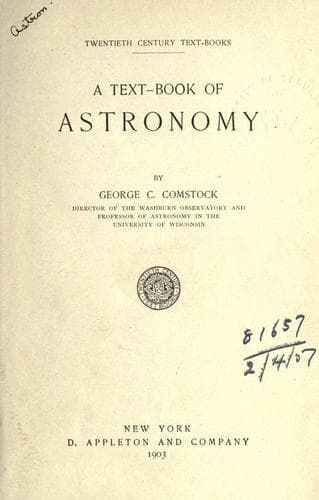
A Text-Book of AstronomyComstock, George C. (George Cary)
Science
A Text-Book of Astronomy
Comstock, George C. (George Cary)
Astronomy
Observe the fluctuations, the ebb and flow, which are inherent in this
process. From sunset to sunrise there is nothing to compensate the
steady outflow of heat, and air and ground grow steadily colder, but
with the sunrise there comes an influx of solar heat, feeble at first
because it strikes the earth's surface very obliquely, but becoming more
and more efficient as the sun rises higher in the sky. But as the air
and the ground grow warm during the morning hours they part more and
more readily and rapidly with their store of heat, just as a steam pipe
or a cup of coffee radiates heat more rapidly when very hot. The warmest
hour of the day is reached when these opposing tendencies of income and
expenditure of heat are just balanced; and barring such disturbing
factors as wind and clouds, the gain in temperature usually extends to
the time--an hour or two beyond noon--at which the diminishing altitude
of the sun renders his rays less efficient, when radiation gains the
upper hand and the temperature becomes for a short time stationary, and
then commences to fall steadily until the next sunrise.
We have here an example of what is called a periodic change--i. e., one
which, within a definite and uniform period (24 hours), oscillates from
a minimum up to a maximum temperature and then back again to a minimum,
repeating substantially the same variation day after day. But it must be
understood that minor causes not taken into account above, such as
winds, water, etc., produce other fluctuations from day to day which
sometimes obscure or even obliterate the diurnal variation of
temperature caused by the sun.
Expose the back of your hand to the sun, holding the hand in such a
position that the sunlight strikes perpendicularly upon it; then turn
the hand so that the light falls quite obliquely upon it and note how
much more vigorous is the warming effect of the sun in the first
position than in the second. It is chiefly this difference of angle that
makes the sun's warmth more effective when he is high up in the sky than
when he is near the horizon, and more effective in summer than in
winter.
Public-domain text, read in full here on John Shaqi.
Reviews
Reviews
No reviews yet
Be the first to share your thoughts on this work.
Join the Discussion
Join the discussion
Sign in to leave a comment or review.
Sign InorCreate an account