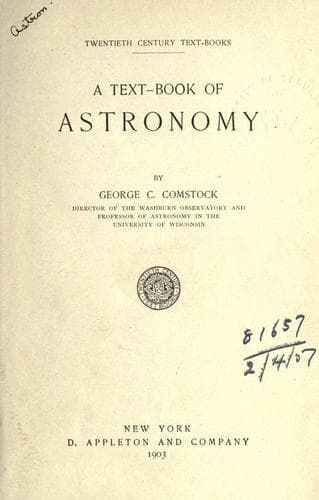
A Text-Book of AstronomyComstock, George C. (George Cary)
Science
A Text-Book of Astronomy
Comstock, George C. (George Cary)
Astronomy
We have seen in Chapter III that the sun's motion among the stars takes
place along a path which carries it alternately north and south of the
equator to a distance of 23.5°, and the stars show by their earlier
risings and later settings, as we pass from the equator toward the north
pole of the heavens, that as the sun moves northward from the equator,
each day in the northern hemisphere will become a little longer, each
night a little shorter, and every day the sun will rise higher toward
the zenith until this process culminates toward the end of June, when
the sun begins to move southward, bringing shorter days and smaller
altitudes until the Christmas season, when again it is reversed and the
sun moves northward. We have here another periodic variation, which runs
its complete course in a period of a year, and it is easy to see that
this variation must have a marked effect on the warming of the earth,
the long days and great altitudes of summer producing the greater warmth
of that season, while the shorter days and lower altitudes of December,
by diminishing the daily supply of solar heat, bring on the winter's
cold. The succession of the seasons, winter following summer and summer
winter, is caused by the varying altitude of the sun, and this in turn
is due to the obliquity of the ecliptic, or, what is the same thing, the
amount by which the axis of the earth is tipped from being perpendicular
to the plane of its orbit, and the seasons are simply a periodic change
in the warming of the earth, quite comparable with the diurnal change
but of longer period.
It is evident that the period within which the succession of winter and
summer is completed, the year, as we commonly call it, must equal the
time required by the sun to go from the vernal equinox around to the
vernal equinox again, since this furnishes a complete cycle of the sun's
motions north and south from the equator. On account of the westward
motion of the equinox (precession) this is not quite the same as the
time required for a complete revolution of the earth in its orbit, but
is a little shorter (20m. 23s.), since the equinox moves back to meet
the sun.
48. RELATION OF THE SUN TO CLIMATE.--It is clear that both the northern
and southern hemispheres of the earth must have substantially the same
kind of seasons, since the motion of the sun north and south affects
both alike; but when the sun is north of the equator and warming our
hemisphere most effectively, his light falls more obliquely upon the
other hemisphere, the days there are short and winter reigns at the
time we are enjoying summer, while six months later the conditions are
reversed.
Public-domain text, read in full here on John Shaqi.
Reviews
Reviews
No reviews yet
Be the first to share your thoughts on this work.
Join the Discussion
Join the discussion
Sign in to leave a comment or review.
Sign InorCreate an account