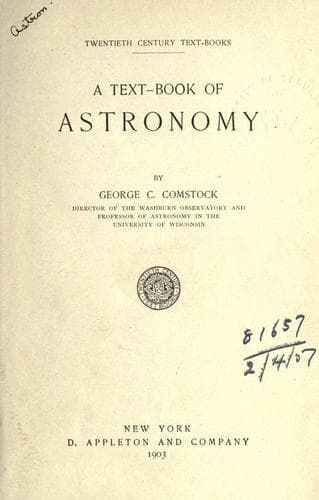
A Text-Book of AstronomyComstock, George C. (George Cary)
Science
A Text-Book of Astronomy
Comstock, George C. (George Cary)
Astronomy
and September 14 is the date fixed by act of Parliament to correspond to
September 3, 1752, O. S. Columbus discovered America on October 12,
1492, O. S. What is the corresponding date in the Gregorian calendar?
62. THE DAY OF THE WEEK.--A problem similar to the above but more
complicated consists in finding the day of the week on which any given
date of the Gregorian calendar falls--e. g., October 21, 1492.
The formula for this case is
7q + r = Y + D + (Y - 1)/4 - (Y - 1)/100 + (Y - 1)/400
where _Y_ denotes the given year, _D_ the number of the day (date) in
that year, and _q_ and _r_ are respectively the quotient and the
remainder obtained by dividing the second member of the equation by 7.
If _r_ = 1 the date falls on Sunday, etc., and if _r_ = 0 the day is
Saturday. For the example suggested above we have
Jan. 31
Feb. 29
Mch. 31
April 30
May 31
June 30
July 31
Aug. 31
Sept. 30
Oct. 21
---
D = 295
Y = 1492
+ D = + 295
+ (Y - 1) ÷ 4 = + 372
- (Y - 1) ÷ 100 = - 14
+ (Y - 1) ÷ 400 = + 3
-------
7) 2148
_q_ = 306
_r_ = 6 = Friday.
Find from some history the day of the week on which Columbus first saw
America, and compare this with the above.
On what day of the week did last Christmas fall? On what day of the week
were you born? In the formula for the day of the week why does _q_ have
the coefficient 7? What principles in the calendar give rise to the
divisors 4, 100, 400?
For much curious and interesting information about methods of reckoning
the lapse of time the student may consult the articles Calendar and
Chronology in any good encyclopædia.
[Illustration: THE YERKES OBSERVATORY, WILLIAMS BAY, WIS.]
CHAPTER VII
ECLIPSES
63. THE NATURE OF ECLIPSES.--Every planet has a shadow which travels
with the planet along its orbit, always pointing directly away from the
sun, and cutting off from a certain region of space the sunlight which
otherwise would fill it. For the most part these shadows are invisible,
but occasionally one of them falls upon a planet or some other body
which shines by reflected sunlight, and, cutting off its supply of
light, produces the striking phenomenon which we call an eclipse. The
satellites of Jupiter, Saturn, and Mars are eclipsed whenever they
plunge into the shadows cast by their respective planets, and Jupiter
himself is partially eclipsed when one of his own satellites passes
between him and the sun, and casts upon his broad surface a shadow too
small to cover more than a fraction of it.
Public-domain text, read in full here on John Shaqi.
Reviews
Reviews
No reviews yet
Be the first to share your thoughts on this work.
Elsewhere in the archive
Join the Discussion
Join the discussion
Sign in to leave a comment or review.
Sign InorCreate an account