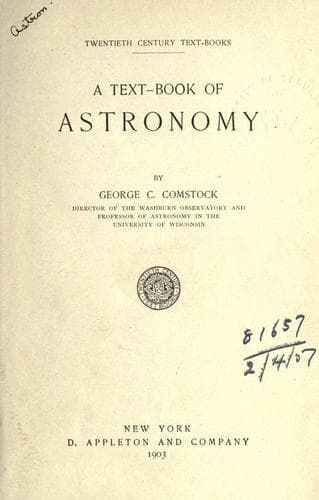
A Text-Book of AstronomyComstock, George C. (George Cary)
Science
A Text-Book of Astronomy
Comstock, George C. (George Cary)
Astronomy
73. USE OF ECLIPSES.--At all times and among all peoples eclipses, and
particularly total eclipses of the sun, have been reckoned among the
most impressive phenomena of Nature. In early times and among
uncultivated people they were usually regarded with apprehension, often
amounting to a terror and frenzy, which civilized travelers have not
scrupled to use for their own purposes with the aid of the eclipse
predictions contained in their almanacs, threatening at the proper time
to destroy the sun or moon, and pointing to the advancing eclipse as
proof that their threats were not vain. In our own day and our own land
these feelings of awe have not quite disappeared, but for the most part
eclipses are now awaited with an interest and pleasure which, contrasted
with the former feelings of mankind, furnish one of the most striking
illustrations of the effect of scientific knowledge in transforming
human fear and misery into a sense of security and enjoyment.
But to the astronomer an eclipse is more than a beautiful illustration
of the working of natural laws; it is in varying degree an opportunity
of adding to his store of knowledge respecting the heavenly bodies. The
region immediately surrounding the sun is at most times closed to
research by the blinding glare of the sun's own light, so that a planet
as large as the moon might exist here unseen were it not for the
occasional opportunity presented by a total eclipse which shuts off the
excessive light and permits not only a search for unknown planets but
for anything and everything which may exist around the sun. More than
one astronomer has reported the discovery of such planets, and at least
one of these has found a name and a description in some of the books,
but at the present time most astronomers are very skeptical about the
existence of any such object of considerable size, although there is
some reason to believe that an enormous number of little bodies, ranging
in size from grains of sand upward, do move in this region, as yet
unseen and offering to the future problems for investigation.
But in other directions the study of this region at the times of total
eclipse has yielded far larger returns, and in the chapter on the sun we
shall have to consider the marvelous appearances presented by the solar
prominences and by the corona, an appendage of the sun which reaches out
from his surface for millions of miles but is never seen save at an
eclipse. Photographs of the corona are taken by astronomers at every
opportunity, and reproductions of some of these may be found in Chapter
X.
Public-domain text, read in full here on John Shaqi.
Reviews
Reviews
No reviews yet
Be the first to share your thoughts on this work.
Elsewhere in the archive
Join the Discussion
Join the discussion
Sign in to leave a comment or review.
Sign InorCreate an account