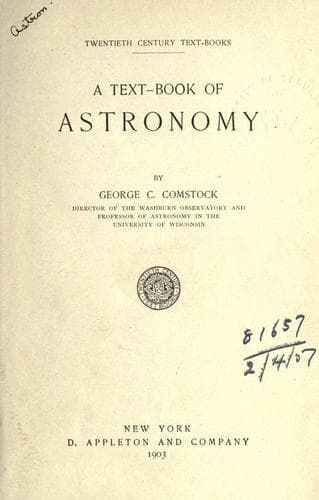
A Text-Book of AstronomyComstock, George C. (George Cary)
Science
A Text-Book of Astronomy
Comstock, George C. (George Cary)
Astronomy
The student will note that for the sake of greater precision we here
say _wave front_ instead of wave. If in any wave we imagine a line drawn
along the crest, so as to touch every drop which at that moment is
exactly at the crest, we shall have what is called a wave front, and
similarly a line drawn through the trough between two waves, or through
any set of drops similarly placed on a wave, constitutes a wave front.
77. MIRRORS AND LENSES.--That form of radiant energy which we recognize
as light and heat may be reflected and condensed precisely as are the
waves of water in the exercise considered above, but owing to the
extreme shortness of the wave length in this case the reflecting surface
should be very smooth and highly polished. A piece of glass hollowed out
in the center by grinding, and with a light film of silver chemically
deposited upon the hollow surface and carefully polished, is often used
by astronomers for this purpose, and is called a concave mirror.
The radiant energy coming from a star or other distant object and
falling upon the silvered face of such a mirror is reflected and
condensed at a point a little in front of the mirror, and there forms an
image of the star, which may be seen with the unaided eye, if it is held
in the right place, or may be examined through a magnifying glass.
Similarly, an image of the sun, a planet, or a distant terrestrial
object is formed by the mirror, which condenses at its appropriate place
the radiant energy proceeding from each and every point in the surface
of the object, and this, in common phrase, produces an image of the
object.
Public-domain text, read in full here on John Shaqi.
Reviews
Reviews
No reviews yet
Be the first to share your thoughts on this work.
Elsewhere in the archive
Join the Discussion
Join the discussion
Sign in to leave a comment or review.
Sign InorCreate an account