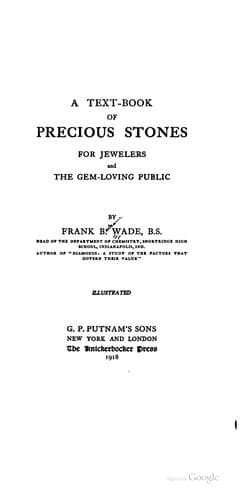
A Text-Book of Precious Stones for Jewelers and the Gem-Loving PublicWade, Frank Bertram
Science
A Text-Book of Precious Stones for Jewelers and the Gem-Loving Public
Wade, Frank Bertram
Precious stones
Artificial pearls may also be detected by their incorrect specific
gravity, by their incorrect degree of hardness, and in the case of the
hollow pearls by making a tiny ink spot upon the surface of the "pearl"
and looking at it through a lens. A reflection of the spot from the
_inside_ surface of the bead will appear beside the spot itself if the
pearl is of the Roman type.
The artificial pearls so far described are high class products. Some of
the very cheap and poor imitations are merely solid, or hollow, glass or
enamel beads which have been made slightly pearly, either by adding
various materials to the glass or enamel when it was made, or by crudely
coating the beads without or within with wax containing cheap "nacre."
LESSON XXIX
THE USE OF BALANCES AND THE UNIT OF WEIGHT IN USE FOR PRECIOUS STONES
As precious stones are almost always sold by weight, and as the value at
stake is frequently very great, it is almost as necessary for a gem
merchant, as it is for the chemist, to have delicate balances and to
keep them in good order and to use them skillfully.
A general understanding of the unit of weight in use for precious stones
and how it is related to other standard weights is also necessary to the
gem dealer. We will therefore consider in this lesson the use and care
of balances and the nature and relative value of the unit of weight for
precious stones.
DELICATE BALANCES NEEDED. As it is necessary, on account of their great
value, to weigh some gems, such as diamonds, emeralds, rubies, etc.,
with accuracy to at least the one hundredth part of a carat (which is
roughly in the neighborhood of 1/15,000 of an ounce avoirdupois),
balances of very delicate and accurate construction are a necessary part
of the equipment of every gem merchant. While portable balances of a
fair degree of accuracy are to be had, the best and surest balances are
substantially constructed and housed in glass cases, much as are those
of the analytic chemist, which must do even finer weighing. The case
protects the balance from dust and dirt and prevents the action of air
currents during the weighing. The balance itself has very delicate knife
edges, sometimes of agate, sometimes of hardened steel, and these knife
edges rest, when in use, on a block of agate or steel, so that there is
a minimum amount of friction. When not in use the balance beam and knife
edges are lifted from the block and held firmly by a metal arm, or else,
as is the case with some balances, the post supporting the block is
lowered, leaving the beam and knife edges out of contact with it. The
object of this separation is to prevent any rough contact between the
knife edges and the block on which they rest. Advantage should always be
taken of this device whenever any fairly heavy load is put on or taken
off of either pan, as the sudden tipping of the beam might chip the
knife edges if not supported. When the load is nearly balanced there may
Public-domain text, read in full here on John Shaqi.
Reviews
Reviews
No reviews yet
Be the first to share your thoughts on this work.
Elsewhere in the archive
Join the Discussion
Join the discussion
Sign in to leave a comment or review.
Sign InorCreate an account