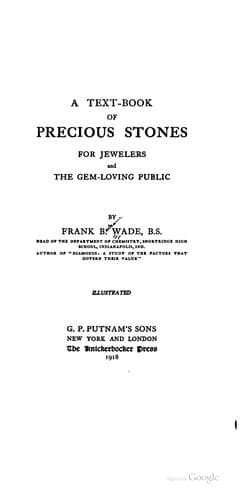
A Text-Book of Precious Stones for Jewelers and the Gem-Loving PublicWade, Frank Bertram
Science
A Text-Book of Precious Stones for Jewelers and the Gem-Loving Public
Wade, Frank Bertram
Precious stones
It should be unnecessary to add that accurate weights _should never be
handled with the fingers_. Ivory tipped forceps are best for handling
the weights. The forceps commonly used for handling diamonds will, in
time, wear away the weights by scratching them so that they will weigh
materially less. Unless the weights are of platinum or plated with
gold, the perspiration of the hands would cause them to oxidize and gain
in weight. It would be well to discard the smaller weights, which are
most in use, every few years and obtain new and accurate ones. In case
this is not done one should at least have the weights checked against
others known to be of standard weight. Any chemist will have balances
and weights far more accurate than the best in use for precious stones
and will gladly check the weights of a gem dealer for a moderate fee.
To check the accuracy of your balance, change the stone and weights to
opposite pans, in which case they should still balance.
One should never overload a balance, both because the balance might be
injured and because the relative accuracy decreases as the load
increases. If the weight of a parcel of stones heavier than the total of
the weights provided with the balance is desired, the parcel should be
divided and weighed in parts.
While many dealers neglect some of the precautions above suggested and
somehow get along, yet it is safer to use care and to have correct
technique in the handling of one's balances.
Having indicated a few of the refinements of method in weighing we will
next consider the unit of weight in use for precious stones and see how
it is related to other units of weight and in what manner it is
subdivided.
THE UNIT OF WEIGHT FOR PRECIOUS STONES. The present unit for precious
stones in the United States is the _metric carat_. Most of the more
progressive countries have in recent years agreed upon the use of this
unit. Its use in the United States became general July 1, 1913. It is by
definition exactly one fifth of a _gram_ (the unit of weight of the
_Metric System_ of weights and measures). Its relation to the _grain_ is
that there are 3.08+ grains in the metric carat. The carat in use in
this country up to a few years ago was about 2-1/2% heavier than the
present metric carat. It was equal to .2053 grams instead of .2000
grams (1/5 gram). The carats of countries not using the metric carat
vary considerably, but yet approximate the metric carat somewhat nearly.
Public-domain text, read in full here on John Shaqi.
Reviews
Reviews
No reviews yet
Be the first to share your thoughts on this work.
Elsewhere in the archive
Join the Discussion
Join the discussion
Sign in to leave a comment or review.
Sign InorCreate an account