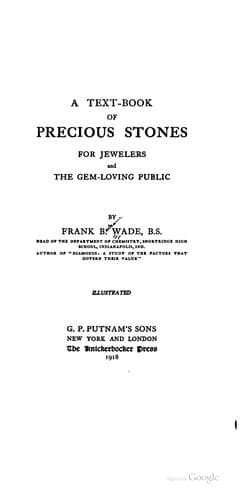
A Text-Book of Precious Stones for Jewelers and the Gem-Loving PublicWade, Frank Bertram
Science
A Text-Book of Precious Stones for Jewelers and the Gem-Loving Public
Wade, Frank Bertram
Precious stones
MINERAL SPECIES. We must first consider what is meant by a "mineral
species" and find out what relation exists between that subject and
chemical composition. Now by a "mineral species" is understood a single
substance, having (except for mechanically admixed impurities)
practically a constant chemical composition, and having practically
identical physical properties in all specimens of it.
DIAMOND AND CORUNDUM. A chemist would call a true mineral a _pure
substance_, just as sugar and salt are pure substances to the chemist.
Thus _diamond_ is a "mineral species," as is also _corundum_. There are
many different colors of both diamond and corundum, but these different
colors are believed to be due to the presence in the pure substance of
impurities in small amounts. Thus every diamond consists mainly of pure
carbon, and all the corundum gems (_ruby_ and the various colors of
_sapphire_) consist mainly of pure oxide of aluminum. The properties of
all diamonds are practically alike and so are the properties of all the
corundum gems whether red (ruby), blue (sapphire), yellow (Oriental
topaz), green (Oriental emerald), or purple (Oriental amethyst).
Thus all diamonds, of whatever color, belong to the one species,
diamond, and in this case the usual custom in naming them agrees with
the facts. Similarly all sapphires, of whatever color, belong to the
mineral species "corundum." Thus a ruby is a red corundum.
The old French traveler and gem merchant, Tavernier, tells us that in
the seventeenth century, when he visited the mines of Pegu, the natives
knew of the similarity of the corundum gems and even called all by one
name, with other names attached to designate the color. Singularly
enough, the common name used by them was _ruby_ rather than sapphire, as
now. Thus they called blue corundum gems blue rubies; yellow corundums,
yellow rubies, etc.
It is easily seen that if one recognizes the similar nature of all the
many colors and shades of corundum that the number of things that one
has to remember in order to be well acquainted with these stones is
considerably diminished. Thus, instead of having a whole series of
specific gravities to remember one has only to remember that all the
corundum gems have a specific gravity of approximately 4. Similarly they
are all of practically the same refractive index (1.761-1.770, being
doubly refracting) that they all exhibit dichroism when at all deeply
colored, etc.
Having thus indicated what we mean by mineral species and having
illustrated the matter by the cases of diamond and corundum and further
having stated that all diamonds are composed of pure carbon (except for
traces of impurities) and all corundum gems mainly of oxide of aluminum,
we may proceed to consider other mineral species and find out what gems
they afford us.
Public-domain text, read in full here on John Shaqi.
Reviews
Reviews
No reviews yet
Be the first to share your thoughts on this work.
Elsewhere in the archive
Join the Discussion
Join the discussion
Sign in to leave a comment or review.
Sign InorCreate an account