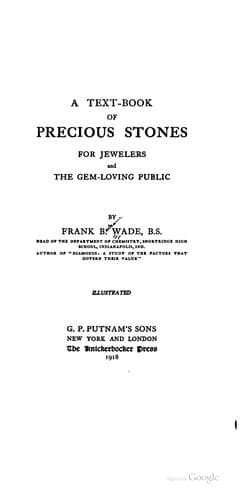
A Text-Book of Precious Stones for Jewelers and the Gem-Loving PublicWade, Frank Bertram
Science
A Text-Book of Precious Stones for Jewelers and the Gem-Loving Public
Wade, Frank Bertram
Precious stones
Leaving the silicates we find very few gem minerals remaining. The
phosphates furnish us _turquoise_, a hydrous aluminum phosphate, with
copper and iron. _Variscite_ is also a phosphate (a hydrated aluminum
phosphate).
The carbonates give us _malachite_ and _azurite_, both carbonates of
copper with combined water, the malachite having more water.
LESSON XIX
THE NAMING OF PRECIOUS STONES
Owing to the confusion which may result from a lack of uniformity in the
naming of precious stones, it is very desirable that jewelers and stone
merchants inform themselves in regard to the correct use of the names of
the gems, and that they use care in speaking and in writing such names.
As nearly all precious and semi-precious stones are derived from a
relatively small number of _mineral species_, as we saw in Lesson
XVIII., and as the science of _mineralogy_ has a very orderly and
systematic method of naming the minerals, the best results are had in
the naming of gems when we use, as far as is possible, the language of
mineralogy.
ANCIENT USAGE. Long established custom and usage, however, must be
observed, for any system of naming must be generally understood in order
to be useful. Thus the proper name for blood red, crystallized oxide of
aluminum, of gem quality, according to the mineralogical system of
naming, would be red _corundum_, but that same material is referred to
in the Old Testament thus (in speaking of wisdom), "She is more precious
than _rubies_." It is obviously necessary to keep and to use all such
terms as have been for years established in usage, even though they do
not agree with the scientific method of naming the particular mineral.
It is, however, necessary that any name, thus retained, should be
correctly used, and that it should not be applied to more than one
material. Thus the term _ruby_ should be reserved exclusively for red
corundum, and not applied to other red minerals such as garnet, spinel,
etc., as is too often done.
It will be the purpose of this lesson to attempt to set forth as clearly
and as briefly as possible what constitutes good usage in the naming of
the principal stones, and also to point out what incorrect usage is most
in need of being avoided.
To cover the subject systematically we will adopt the order of hardness
that we did in discussing mineral species in Lesson XVIII.
Public-domain text, read in full here on John Shaqi.
Reviews
Reviews
No reviews yet
Be the first to share your thoughts on this work.
Elsewhere in the archive
Join the Discussion
Join the discussion
Sign in to leave a comment or review.
Sign InorCreate an account