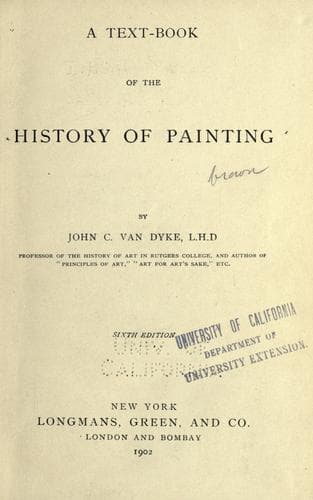
A Text-Book of the History of PaintingVan Dyke, John C.
History
A Text-Book of the History of Painting
Van Dyke, John C.
Painting -- History
SCHOOL OF BRUGES: Painting in Flanders starts abruptly with the
fifteenth century. What there was before that time more than
miniatures and illuminations is not known. Time and the Iconoclasts
have left no remains of consequence. Flemish art for us begins with
Hubert van Eyck (?-1426) and his younger brother Jan van Eyck
(?-1440). The elder brother is supposed to have been the better
painter, because the most celebrated work of the brothers--the St.
Bavon altar-piece, parts of which are in Ghent, Brussels, and
Berlin--bears the inscription that Hubert began it and Jan finished
it. Hubert was no doubt an excellent painter, but his pictures are few
and there is much discussion whether he or Jan painted them. For
historical purposes Flemish art was begun, and almost completed, by
Jan van Eyck. He had all the attributes of the early men, and was one
of the most perfect of Flemish painters. He painted real forms and
real life, gave them a setting in true perspective and light, and put
in background landscapes with a truthful if minute regard for the
facts. His figures in action had some awkwardness, they were small of
head, slim of body, and sometimes stumbled; but his modelling of
faces, his rendering of textures in cloth, metal, stone, and the like,
his delicate yet firm _facture_ were all rather remarkable for his
time. None of this early Flemish art has the grandeur of Italian
composition, but in realistic detail, in landscape, architecture,
figure, and dress, in pathos, sincerity, and sentiment it is
unsurpassed by any fifteenth-century art.
[Illustration: FIG. 75.--MEMLING (?). ST. LAWRENCE (DETAIL). NAT.
GAL., LONDON.]
Little is known of the personal history of either of the Van Eycks.
They left an influence and had many followers, but whether these were
direct pupils or not is an open question. Peter Cristus (1400?-1472)
was perhaps a pupil of Jan, though more likely a follower of his
methods in color and general technic. Roger van der Weyden
(1400?-1464), whether a pupil of the Van Eycks or a rival, produced a
similar style of art. His first master was an obscure Robert Campin.
He was afterward at Bruges, and from there went to Brussels and
founded a school of his own called the
SCHOOL OF BRABANT: He was more emotional and dramatic than Jan van
Eyck, giving much excited action and pathetic expression to his
figures in scenes from the passion of Christ. He had not Van Eyck's
skill, nor his detail, nor his color. More of a draughtsman than a
colorist, he was angular in figure and drapery, but had honesty,
pathos, and sincerity, and was very charming in bright background
landscapes. Though spending some time in Italy, he was never
influenced by Italian art. He was always Flemish in type, subject, and
method, a trifle repulsive at first through angularity and emotional
exaggeration, but a man to be studied.
Public-domain text, read in full here on John Shaqi.
Reviews
Reviews
No reviews yet
Be the first to share your thoughts on this work.
Elsewhere in the archive
Join the Discussion
Join the discussion
Sign in to leave a comment or review.
Sign InorCreate an account