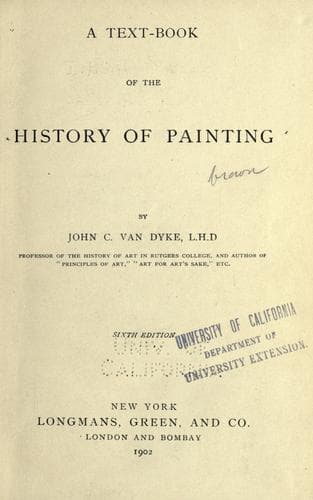
A Text-Book of the History of PaintingVan Dyke, John C.
History
A Text-Book of the History of Painting
Van Dyke, John C.
Painting -- History
Hobbema (1638?-1709) was probably the pupil of Jacob van Ruisdael, and
ranks with him, if not above him, in seventeenth-century landscape
painting. Ruisdael hardly ever painted sunlight, whereas Hobbema
rather affected it in quiet wood-scenes or roadways with little pools
of water and a mill. He was a freer man with the brush than Ruisdael,
and knew more about the natural appearance of trees, skies, and
lights; but, like his master, his view of nature found no favor in his
own land. Most of his work is in England, where it had not a little to
do with influencing such painters as Constable and others at the
beginning of the nineteenth century.
[Illustration: FIG. 85.--ISRAELS. ALONE IN THE WORLD.]
LANDSCAPE WITH CATTLE: Here we meet with Wouverman (1619-1668), a
painter of horses, cavalry, battles, and riding parties placed in
landscape. His landscape is bright and his horses are spirited in
action. There is some mannerism apparent in his reiterated
concentration of light on a white horse, and some repetition in his
canvases, of which there are many; but on the whole he was an
interesting, if smooth and neat painter. Paul Potter (1625-1654)
hardly merited his great repute. He was a harsh, exact recorder of
facts, often tin-like or woodeny in his cattle, and not in any way
remarkable in his landscapes, least of all in their composition. The
Young Bull at the Hague is an ambitious piece of drawing, but is not
successful in color, light, or _ensemble_. It is a brittle work all
through, and not nearly so good as some smaller things in the National
Gallery London, and in the Louvre. Adrien van de Velde (1635?-1672)
was short-lived, like Potter, but managed to do a prodigious amount
of work, showing cattle and figures in landscape with much technical
ability and good feeling. He was particularly good in composition and
the subtle gradation of neutral tints. A little of the Italian
influence appeared in his work, and with the men who came with him and
after him the Italian imitation became very pronounced. Aelbert Cuyp
(1620-1691) was a many-sided painter, adopting at various times
different styles, but was enough of a genius to be himself always. He
is best known to us, perhaps, by his yellow sunlight effects along
rivers, with cattle in the foreground, though he painted still-life,
and even portraits and marines. In composing a group he was knowing,
recording natural effects with power; in light and atmosphere he was
one of the best of his time, and in texture and color refined, and
frequently brilliant. Both (1610-1650?), Berchem (1620-1683), Du
Jardin (1622?-1678), followed the Italian tradition of Claude Lorrain,
producing semi-classic landscapes, never very convincing in their
originality. Van der Heyden (1637-1712), should be mentioned as an
excellent, if minute, painter of architecture with remarkable
atmospheric effects.
Public-domain text, read in full here on John Shaqi.
Reviews
Reviews
No reviews yet
Be the first to share your thoughts on this work.
Elsewhere in the archive
Join the Discussion
Join the discussion
Sign in to leave a comment or review.
Sign InorCreate an account