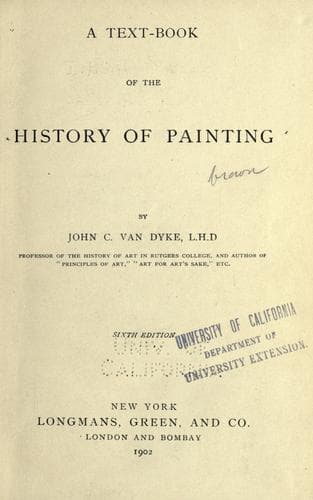
A Text-Book of the History of PaintingVan Dyke, John C.
History
A Text-Book of the History of Painting
Van Dyke, John C.
Painting -- History
Their success has
been in portraiture and landscape, and this largely by reason of
following the model.
EARLY PAINTING: The earliest decorative art appeared in Ireland. It
was probably first planted there by missionaries from Italy, and it
reached its height in the seventh century. In the ninth and tenth
centuries missal illumination of a Byzantine cast, with local
modifications, began to show. This lasted, in a feeble way, until the
fifteenth century, when work of a Flemish and French nature took its
place. In the Middle Ages there were wall paintings and church
decorations in England, as elsewhere in Europe, but these have now
perished, except some fragments in Kempley Church, Gloucestershire,
and Chaldon Church, Surrey. These are supposed to date back to the
twelfth century, and there are some remains of painting in Westminster
Abbey that are said to be of thirteenth and fourteenth-century origin.
From the fifteenth to the eighteenth century the English people
depended largely upon foreign painters who came and lived in England.
Mabuse, Moro, Holbein, Rubens, Van Dyck, Lely, Kneller--all were there
at different times, in the service of royalty, and influencing such
local English painters as then lived. The outcome of missal
illumination and Holbein's example produced in the sixteenth and
seventeenth centuries a local school of miniature-painters of much
interest, but painting proper did not begin to rise in England until
the beginning of the eighteenth century--that century so dead in art
over all the rest of Europe.
FIGURE AND PORTRAIT PAINTERS: Aside from a few inconsequential
precursors the first English artist of note was Hogarth (1697-1764).
He was an illustrator, a moralist, and a satirist as well as a
painter. To point a moral upon canvas by depicting the vices of his
time was his avowed aim, but in doing so he did not lose sight of
pictorial beauty. Charm of color, the painter's taste in arrangement,
light, air, setting, were his in a remarkable degree. He was not
successful in large compositions, but in small pictures like those of
the Rake's Progress he was excellent. An early man, a rigid stickler
for the representation, a keen observer of physiognomy, a satirist
with a sense of the absurd, he was often warped in his art by the
necessities of his subject and was sometimes hard and dry in method,
but in his best work he was quite a perfect painter. He was the first
of the English school, and perhaps the most original of that school.
This is quite as true of his technic as of his point of view. Both
were of his own creation. His subjects have been talked about a great
deal in the past; but his painting is not to this day valued as it
should be.
[Illustration: FIG. 95.--REYNOLDS. COUNTESS SPENCER AND LORD ALTHORP.]
Public-domain text, read in full here on John Shaqi.
Reviews
Reviews
No reviews yet
Be the first to share your thoughts on this work.
Elsewhere in the archive
Join the Discussion
Join the discussion
Sign in to leave a comment or review.
Sign InorCreate an account