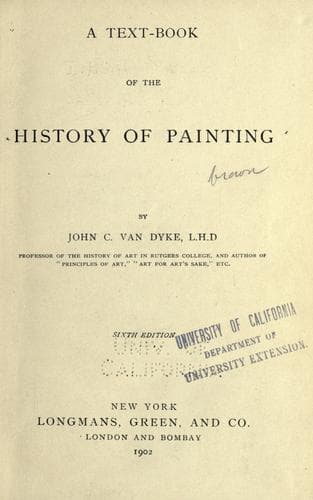
A Text-Book of the History of PaintingVan Dyke, John C.
History
A Text-Book of the History of Painting
Van Dyke, John C.
Painting -- History
THE WATER-COLORISTS: About the beginning of this century a school of
water-colorists, founded originally by Cozens (1752-1799) and Girtin
(1775-1802), came into prominence and developed English art in a new
direction. It began to show with a new force the transparency of
skies, the luminosity of shadows, the delicacy and grace of clouds,
the brilliancy of light and color. Cozens and Blake were primitives in
the use of the medium, but Stothard (1755-1834) employed it with much
sentiment, charm, and _plein-air_ effect. Turner was quite a master of
it, and his most permanent work was done with it. Later on, when he
rather abandoned form to follow color, he also abandoned water-color
for oils. Fielding (1787-1849) used water-color effectively in giving
large feeling for space and air, and also for fogs and mists; Prout
(1783-1852) employed it in architectural drawings of the principal
cathedrals of Europe; and Cox (1783-1859), Dewint (1784-1849), Hunt
(1790-1864), Cattermole (1800-1868), Lewis (1805-1876), men whose
names only can be mentioned, all won recognition with this medium.
Water-color drawing is to-day said to be a department of art that
expresses the English pictorial feeling better than any other, though
this is not an undisputed statement.
[Illustration: FIG. 100.--LEIGHTON. HELEN OF TROY.]
Perhaps the most important movement in English painting of recent
times was that which took the name of
PRE-RAPHAELITISM: It was started about 1847, primarily by Rossetti
(1828-1882), Holman Hunt (1827-), and Sir John Millais (1829-1896),
associated with several sculptors and poets, seven in all. It was an
emulation of the sincerity, the loving care, and the scrupulous
exactness in truth that characterized the Italian painters before
Raphael. Its advocates, including Mr. Ruskin the critic, maintained
that after Raphael came that fatal facility in art which seeking grace
of composition lost truth of fact, and that the proper course for
modern painters was to return to the sincerity and veracity of the
early masters. Hence the name pre-Raphaelitism, and the signatures on
their early pictures, P. R. B., pre-Raphaelite Brother. To this
attempt to gain the true regardless of the sensuous, was added a
morbidity of thought mingled with mysticism, a moral and religious
pose, and a studied simplicity. Some of the painters of the
Brotherhood went even so far as following the habits of the early
Italians, seeking retirement from the world and carrying with them a
Gothic earnestness of air. There is no doubt about the sincerity that
entered into this movement. It was an honest effort to gain the true,
the good, and as a result, the beautiful; but it was no less a
striven-after honesty and an imitated earnestness. The Brotherhood did
not last for long, the members drifted from each other and began to
paint each after his own style, and pre-Raphaelitism passed away as it
had arisen, though not without leaving a powerful stamp on English
Public-domain text, read in full here on John Shaqi.
Reviews
Reviews
No reviews yet
Be the first to share your thoughts on this work.
Elsewhere in the archive
Join the Discussion
Join the discussion
Sign in to leave a comment or review.
Sign InorCreate an account