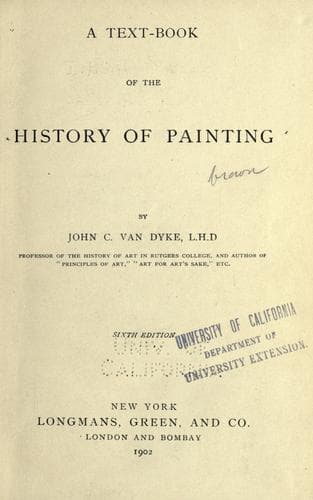
A Text-Book of the History of PaintingVan Dyke, John C.
History
A Text-Book of the History of Painting
Van Dyke, John C.
Painting -- History
THE MIDDLE PERIOD in American art dates from 1825 to about 1878. During
that time, something distinctly American began to appear in the
landscape work of Doughty (1793-1856) and Thomas Cole (1801-1848). Both
men were substantially self-taught, though Cole received some
instruction from a portrait-painter named Stein. Cole during his life
was famous for his Hudson River landscapes, and for two series of
pictures called The Voyage of Life and The Course of Empire. The latter
were really epic poems upon canvas, done with much blare of color and
literary explanation in the title. His best work was in pure landscape,
which he pictured with considerable accuracy in drawing, though it was
faulty in lighting and gaudy in coloring. Brilliant autumn scenes were
his favorite subjects. His work had the merit of originality and,
moreover, it must be remembered that Cole was one of the beginners in
American landscape art. Durand (1796-1886) was an engraver until 1835,
when he began painting portraits, and afterward developed landscape with
considerable power. He was usually simple in subject and realistic in
treatment, with not so much insistence upon brilliant color as some of
his contemporaries. Kensett (1818-1872) was a follower in landscape of
the so-called Hudson River School of Cole and others, though he studied
seven years in Europe. His color was rather warm, his air hazy, and the
general effect of his landscape that of a dreamy autumn day with poetic
suggestions. F. E. Church (1826-[A]) was a pupil of Cole, and has
followed him in seeking the grand and the startling in mountain scenery.
With Church should be mentioned a number of artists--Hubbard
(1817-1888), Hill (1829-,) Bierstadt (1830-),[21] Thomas Moran
(1837-)--who have achieved reputation by canvases of the Rocky Mountains
and other expansive scenes. Some other painters of smaller canvases
belong in point of time, and also in spirit, with the Hudson River
landscapists--painters, too, of considerable merit, as David Johnson
(1827-), Bristol (1826-), Sandford Gifford (1823-1880), McEntee
(1828-1891), and Whittredge (1820-), the last two very good portrayers
of autumn scenes; A. H. Wyant (1836-1892), one of the best and strongest
of the American landscapists; Bradford (1830-1892) and W. T. Richards
(1833-), the marine-painters.
[Footnote 21: Died, 1900.]
[Illustration: FIG. 105.--EASTMAN JOHNSON. CHURNING.]
Public-domain text, read in full here on John Shaqi.
Reviews
Reviews
No reviews yet
Be the first to share your thoughts on this work.
Elsewhere in the archive
Join the Discussion
Join the discussion
Sign in to leave a comment or review.
Sign InorCreate an account