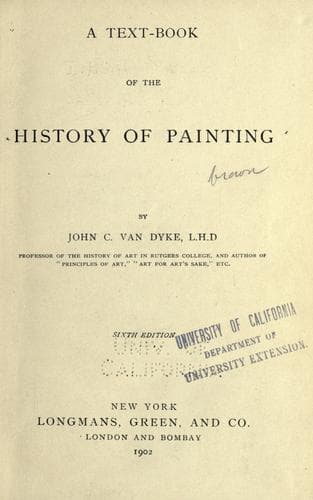
A Text-Book of the History of PaintingVan Dyke, John C.
History
A Text-Book of the History of Painting
Van Dyke, John C.
Painting -- History
Andrea del Sarto (1486-1531) was a Florentine pure and simple--a
painter for the Church producing many madonnas and altar-pieces, and
yet possessed of little religious feeling or depth. He was a painter
more than a pietist, and was called by his townsmen "the faultless
painter." So he was as regards the technical features of his art. He
was the best brushman and colorist of the Florentine school. Dealing
largely with the material side his craftsmanship was excellent and his
pictures exuberant with life and color, but his madonnas and saints
were decidedly of the earth--handsome Florentine models garbed as
sacred characters--well-drawn and easily painted, with little
devotional feeling about them. He was influenced by other painters to
some extent. Masaccio, Ghirlandajo, and Michael Angelo were his models
in drawing; Leonardo and Bartolommeo in contours; while in warmth of
color, brush-work, atmospheric and landscape effects he was quite by
himself. He had a large number of pupils and followers, but most of
them deserted him later on to follow Michael Angelo. Pontormo
(1493-1558) and Franciabigio (1482-1525) were among the best of them.
Michael Angelo (1474-1564) has been called the "Prophet of the
Renaissance," and perhaps deserves the title, since he was more of the
Old Testament than the New--more of the austere and imperious than the
loving or the forgiving. There was no sentimental feature about his
art. His conception was intellectual, highly imaginative, mysterious,
at times disordered and turbulent in its strength. He came the nearest
to the sublime of any painter in history through the sole attribute of
power. He had no tenderness nor any winning charm. He did not win, but
rather commanded. Everything he saw or felt was studied for the
strength that was in it. Religion, Old-Testament history, the antique,
humanity, all turned in his hands into symbolic forms of power, put
forth apparently in the white heat of passion, and at times in
defiance of every rule and tradition of art. Personal feeling was very
apparent in his work, and in this he was as far removed as possible
from the Greeks, and nearer to what one would call to-day a
romanticist. There was little of the objective about him. He was not
an imitator of facts but a creator of forms and ideas. His art was a
reflection of himself--a self-sufficient man, positive, creative,
standing alone, a law unto himself.
Public-domain text, read in full here on John Shaqi.
Reviews
Reviews
No reviews yet
Be the first to share your thoughts on this work.
Elsewhere in the archive
Join the Discussion
Join the discussion
Sign in to leave a comment or review.
Sign InorCreate an account