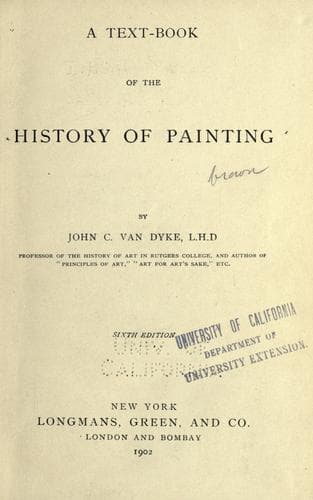
A Text-Book of the History of PaintingVan Dyke, John C.
History
A Text-Book of the History of Painting
Van Dyke, John C.
Painting -- History
Technically, Leonardo was not a handler of the brush superior in any
way to his Florentine contemporaries. He knew all the methods and
mediums of the time, and did much to establish oil-painting among the
Florentines, but he was never a painter like Titian, or even Correggio
or Andrea del Sarto. A splendid draughtsman, a man of invention,
imagination, grace, elegance, and power, he nevertheless carried more
by mental penetration and aesthetic sense than by his technical skill.
He was one of the great men of the Renaissance, and deservedly holds a
place in the front rank.
Though Leonardo's accomplishment seems slight because of the little
that is left to us, yet he had a great following not only among the
Florentines but at Milan, where Vincenza Foppa had started a school in
the Early Renaissance time. Leonardo was there for fourteen years, and
his artistic personality influenced many painters to adopt his type
and methods. Bernardino Luini (1475?-1532?) was the most prominent of
the disciples. He cultivated Leonardo's sentiment, style, subjects,
and composition in his middle period, but later on developed
independence and originality. He came at a period of art when that
earnestness of characterization which marked the early men was giving
way to gracefulness of recitation, and that was the chief feature of
his art. For that matter gracefulness and pathetic sweetness of mood,
with purity of line and warmth of color characterized all the Milanese
painters.
[Illustration: FIG. 44.--LUINI. DAUGHTER OF HERODIAS WITH HEAD OF JOHN
THE BAPTIST. UFFIZI.]
The more prominent lights of the school were Salaino (fl. 1495-1518),
of whose work nothing authentic exists, Boltraffio (1467-1516), a
painter of limitations but of much refinement and purity, and Marco da
Oggiono (1470?-1530) a close follower of Leonardo. Solario
(1458?-1515?) probably became acquainted early with the Flemish mode
of working practised by Antonello da Messina, but he afterward came
under Leonardo's spell at Milan. He was a careful, refined painter,
possessed of feeling and tenderness, producing pictures with enamelled
surfaces and much detail. Gianpietrino (fl. 1520-1540) and Cesare da
Sesto (1477-1523?) were also of the Milanese school, the latter
afterward falling under the Raphael influence. Gaudenzio Ferrara
(1481?-1547?), an exceptionally brilliant colorist and a painter of
much distinction, was under Leonardo's influence at one time, and
with the teachings of that master he mingled a little of Raphael in
the type of face. He was an uneven painter, often excessive in
sentiment, but at his best one of the most charming of the northern
painters.
Public-domain text, read in full here on John Shaqi.
Reviews
Reviews
No reviews yet
Be the first to share your thoughts on this work.
Elsewhere in the archive
Join the Discussion
Join the discussion
Sign in to leave a comment or review.
Sign InorCreate an account