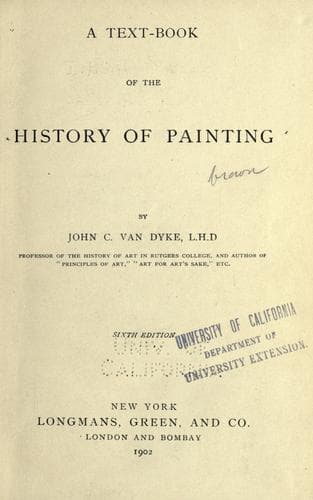
A Text-Book of the History of PaintingVan Dyke, John C.
History
A Text-Book of the History of Painting
Van Dyke, John C.
Painting -- History
Palma's friend and fellow-worker, Lorenzo Lotto (1480?-1556?) came
from the school of the Bellini, and at different times was under the
influence of several Venetian painters--Palma, Giorgione,
Titian--without obliterating a sensitive individuality of his own. He
was a somewhat mannered but very charming painter, and in portraits
can hardly be classed below Titian. Rocco Marconi (fl. 1505-1520) was
another Bellini-educated painter, showing the influence of Palma and
even of Paris Bordone. In color and landscape he was excellent.
Pordenone (1483-1540) rather followed after Giorgione, and
unsuccessfully competed with Titian. He was inclined to exaggeration
in dramatic composition, but was a painter of undeniable power.
Cariani (1480-1541) was another Giorgione follower. Bonifazio Pitati
probably came from a Veronese family. He showed the influence of
Palma, and was rather deficient in drawing, though exceedingly
brilliant and rich in coloring. This latter may be said for Paris
Bordone (1495-1570), a painter of Titian's school, gorgeous in color,
but often lacking in truth of form. His portraits are very fine.
Another painter family, the Bassani--there were six of them, of whom
Jacopo Bassano (1510-1592) and his son Francesco Bassano (1550-1591),
were the most noted--formed themselves after Venetian masters, and
were rather remarkable for violent contrasts of light and dark,
_genre_ treatment of sacred subjects, and still-life and animal
painting.
PAINTING IN VENETIAN TERRITORIES: Venetian painting was not confined to
Venice, but extended through all the Venetian territories in Renaissance
times, and those who lived away from the city were, in their art,
decidedly Venetian, though possessing local characteristics.
At Brescia Savoldo (1480?-1548), a rather superficial painter, fond of
weird lights and sheeny draperies, and Romanino (1485?-1566), a
follower of Giorgione, good in composition but unequal and careless in
execution, were the earliest of the High Renaissance men. Moretto
(1498?-1555) was the strongest and most original, a man of
individuality and power, remarkable technically for his delicacy and
unity of color under a veil of "silvery tone." In composition he was
dignified and noble, and in brush-work simple and direct. One of the
great painters of the time, he seemed to stand more apart from
Venetian influence than any other on Venetian territory. He left one
remarkable pupil, Moroni (fl. 1549-1578) whose portraits are to-day
the gems of several galleries, and greatly admired for their modern
spirit and treatment.
Public-domain text, read in full here on John Shaqi.
Reviews
Reviews
No reviews yet
Be the first to share your thoughts on this work.
Elsewhere in the archive
Join the Discussion
Join the discussion
Sign in to leave a comment or review.
Sign InorCreate an account