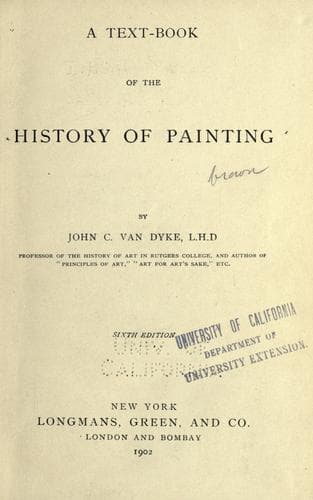
A Text-Book of the History of PaintingVan Dyke, John C.
History
A Text-Book of the History of Painting
Van Dyke, John C.
Painting -- History
THE NATURALISTS: Contemporary with the Eclectics sprang up the
Neapolitan school of the Naturalists, led by Caravaggio (1569-1609)
and his pupils. These schools opposed each other, and yet influenced
each other. Especially was this true with the later men, who took what
was best in both schools. The Naturalists were, perhaps, more firmly
based upon nature than the Bolognese Eclectics. Their aim was to take
nature as they found it, and yet, in conformity with the extravagance
of the age, they depicted extravagant nature. Caravaggio thought to
represent sacred scenes more truthfully by taking his models from the
harsh street life about him and giving types of saints and apostles
from Neapolitan brawlers and bandits. It was a brutal, coarse
representation, rather fierce in mood and impetuous in action, yet not
without a good deal of tragic power. His subjects were rather dismal
or morose, but there was knowledge in the drawing of them, some good
color and brush-work and a peculiar darkness of shadow masses
(originally gained from Giorgione), that stood as an ear-mark of his
whole school. From the continuous use of black shadows the school got
the name of the "Darklings," by which they are still known. Giordano
(1632-1705), a painter of prodigious facility and invention, Salvator
Rosa (1615-1673), best known as one of the early painters of
landscape, and Ribera, a Spanish painter, were the principal pupils.
THE LATE VENETIANS: The Decadence at Venice, like the Renaissance,
came later than at Florence, but after the death of Tintoretto
mannerisms and the imitation of the great men did away with
originality. There was still much color left, and fine ceiling
decorations were done, but the nobility and calm splendor of Titian's
days had passed. Palma il Giovine (1544-1628) with a hasty brush
produced imitations of Tintoretto with some grace and force, and in
remarkable quantity. He and Tintoretto were the most rapid and
productive painters of the century; but Palma's was not good in
spirit, though quite dashing in technic. Padovanino (1590-1650) was
more of a Titian follower, but, like all the other painters of the
time, he was proficient with the brush and lacking in the stronger
mental elements. The last great Italian painter was Tiepolo
(1696-1770), and he was really great beyond his age. With an art
founded on Paolo Veronese, he produced decorative ceilings and panels
of high quality, with wonderful invention, a limpid brush, and a light
flaky color peculiarly appropriate to the walls of churches and
palaces. He was, especially in easel pictures, a brilliant, vivacious
brushman, full of dash and spirit, tempered by a large knowledge of
what was true and pictorial. Some of his best pictures are still in
Venice, and modern painters are unstinted in their praise of them. He
left a son, Domenico Tiepolo (1726-1795), who followed his methods. In
the late days of Venetian painting, Canaletto (1697-1768) and Guardi
Public-domain text, read in full here on John Shaqi.
Reviews
Reviews
No reviews yet
Be the first to share your thoughts on this work.
Elsewhere in the archive
Join the Discussion
Join the discussion
Sign in to leave a comment or review.
Sign InorCreate an account