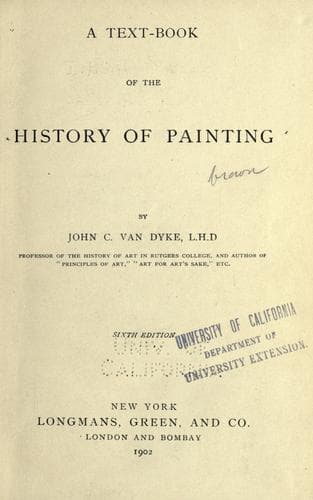
A Text-Book of the History of PaintingVan Dyke, John C.
History
A Text-Book of the History of Painting
Van Dyke, John C.
Painting -- History
After the Restoration David, who had been a revolutionist, and then an
adherent of Napoleon, was sent into exile; but the influence he had
left and the school he had established were carried on by his
contemporaries and pupils. Of the former Regnault (1754-1829), Vincent
(1746-1816), and Prudhon (1758-1823) were the most conspicuous. The
last one was considered as out of the classic circle, but so far as
making his art depend upon drawing and composition, he was a genuine
classicist. His subjects, instead of being heroic, inclined to the
mythological and the allegorical. In Italy he had been a student of
the Renaissance painters, and from them borrowed a method of shadow
gradation that rendered his figures misty and phantom-like. They
possessed an ease of movement sometimes called "Prudhonesque grace,"
and in composition were well placed and effective.
Of David's pupils there were many. Only a few of them, however, had
pronounced ability, and even these carried David's methods into the
theatrical. Girodet (1766-1824) was a draughtsman of considerable
power, but with poor taste in color and little repose in composition.
Most of his work was exaggeration and strained effect. Lethiere
(1760-1832) and Guerin (1774-1833), pupils of Regnault, were painters
akin to Girodet, but inferior to him. Gerard (1770-1837) was a weak
David follower, who gained some celebrity by painting portraits of
celebrated men and women. The two pupils of David who brought him the
most credit were Ingres (1780-1867) and Gros (1771-1835). Ingres was a
cold, persevering man, whose principles had been well settled by David
early in life, and were adhered to with conviction by the pupil to the
last. He modified the classic subject somewhat, studied Raphael and
the Italians, and reintroduced the single figure into art (the Source,
and the Odalisque, for example). For color he had no fancy. "In nature
all is form," he used to say. Painting he thought not an independent
art, but "a development of sculpture." To consider emotion, color, or
light as the equal of form was monstrous, and to compare Rembrandt
with Raphael was blasphemy. To this belief he clung to the end,
faithfully reproducing the human figure, and it is not to be wondered
at that eventually he became a learned draughtsman. His single figures
and his portraits show him to the best advantage. He had a strong
grasp of modelling and an artistic sense of the beauty and dignity of
line not excelled by any artist of this century. And to him more than
any other painter is due the cultured draughtsmanship which is to-day
the just pride of the French school.
Public-domain text, read in full here on John Shaqi.
Reviews
Reviews
No reviews yet
Be the first to share your thoughts on this work.
Elsewhere in the archive
Join the Discussion
Join the discussion
Sign in to leave a comment or review.
Sign InorCreate an account