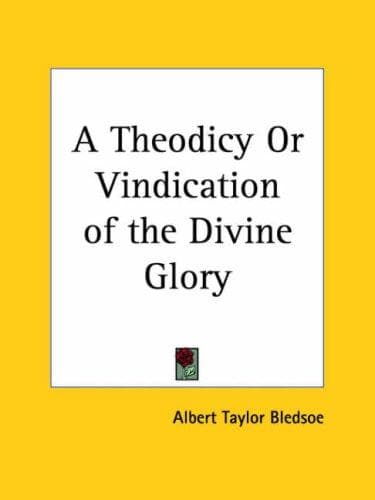
A Theodicy, or, Vindication of the Divine GloryBledsoe, Albert Taylor
Religion
A Theodicy, or, Vindication of the Divine Glory
Bledsoe, Albert Taylor
Theodicy
Instead of attempting to view the existence of evil in the light of any
principle whatever, he merely accumulates evil upon evil; and when the
mass has become sufficiently terrific, with the jeering mockery of a small
fiend, he delights in the contemplation of the awful spectacle as a
conclusive demonstration that the Ruler of the world is unequal to the
government of his creatures. His book is merely an appeal to the ignorance
and feelings of the reader, and can do no mischief, except when it may
happen to find a weak head in union with a corrupt heart. For what does it
signify that the castle of the Baron Thunder-ten-trock was not the most
perfect of all possible castles; does this disprove the skill of the great
Architect of the universe? Or what does it signify that Dr. Pangloss lost
an eye; does this extinguish a single ray of the divine omniscience, or
depose either of the great lights which God ordained to rule the world?
Lastly, what does it signify that M. Voltaire, by a horrible abuse of his
powers, should have extinguished the light of reason in his soul; does
this disprove the goodness of that Being by whom those powers were given
for a higher and a nobler purpose? A fracture in the dome of St. Paul’s
would, no doubt, present as great difficulties to an insect lost in its
depths, as the disorders of this little world presented to the captious
and fault-finding spirit of M. Voltaire; and would as completely shut out
the order and design of the whole structure from its field of vision, as
the order and design of the magnificent temple of the world was excluded
from the mind of this very minute philosopher.
Chapter VII.
Objections Considered.
Heaven seeth all, and therefore knows the sense
Of the whole beauteous frame of Providence.
His judgment of God’s kingdom needs must fail,
Who knows no more of it than this dark jail.—BAXTER.
One part, one little part, we dimly scan,
Through the dark medium of life’s feverish dream;
Yet dare arraign the whole stupendous plan,
If but that little part incongruous seem.—BEATTIE.
Though we have taken great pains to obviate objections by the manner in
which we have unfolded and presented our views, yet we cannot but foresee
that they will have to run the gauntlet of adverse criticism. Indeed, we
could desire nothing more sincerely than such a thing, provided they be
subjected to the test of principle, and not of prejudice. But how can such
a thing be hoped for? Is all theological prejudice and bigotry extinct,
that an author may hope to have a perfectly fair hearing, and impartial
decision? Experience has taught us that we must expect to be assailed by a
great variety of cavils, and that the weakest will often produce as great
an effect as the strongest upon the minds of sectarians. Hence, we shall
endeavour to meet all such objections as may occur to us, provided they
can be supposed to exert any influence over the mind.
Public-domain text, read in full here on John Shaqi.
Reviews
Reviews
No reviews yet
Be the first to share your thoughts on this work.
Elsewhere in the archive
Join the Discussion
Join the discussion
Sign in to leave a comment or review.
Sign InorCreate an account