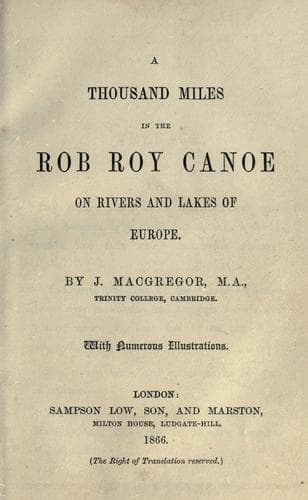
A Thousand Miles in the Rob Roy Canoe on Rivers and Lakes of EuropeMacGregor, John
History
A Thousand Miles in the Rob Roy Canoe on Rivers and Lakes of Europe
MacGregor, John
Canoes and canoeing -- Europe; Europe -- Description and travel; History -- Miscellanea; MacGregor, John, 1825-1892 -- Travel -- Europe
In all these instances the action of the wind has been entirely omitted
from consideration, but it must not be forgotten that a strong breeze
materially complicates the problem before the canoist. This is
especially so when the wind is aft; when it is ahead you are not likely
to forget its presence. A strong fair wind (that has scarcely been felt
with your back to it) and the swift stream and the boat's speed from
paddling being all in one direction, the breeze will suddenly become a
new element in the case when you try to cross above a rock as in fig. 1,
and find the wind carries you broadside on against all your
calculations.
Nor have I any observations to make as to sailing among rocks in a
current. The canoe must be directed solely by the paddle in a long
rapid, and in the other places the course to be steered by a boat
sailing is the same as if it were being merely paddled, though the
action of the wind has to be carefully taken into consideration.
In all these things boldness and skill come only after lessons of
experience, and the canoist will find himself ready and able, at the end
of his voyage, to sail down a rapid which he would have approached
timidly, even with the paddle, at the beginning.
But perhaps enough has been said for the experienced oarsman, while
surely more than enough has been said to shew the tyro aspirant what
varied work he has to do, and how interesting are the circumstances that
will occupy his attention on a delightful river tour.
NOTE ON THE "KENT."--The narrative of a shipwreck referred to at page
219 has been published 40 years ago, and in many foreign languages, but
its circulation is very large at the present time. The following letter
about one of the incidents related in the little book, appeared in the
"Times" of March 22, 1866:--
"LETTERS FROM THE DEEP.
"_To the Editor of the 'Times.'_
"Sir,--As attention has been drawn to the letters written on
board the ship London, and washed ashore, it may be interesting
to notice the following remarkable incident respecting a letter
from another ship wrecked in the Bay of Biscay. In March, 1825,
the Kent, East Indiaman, took fire in the Bay of Biscay during
a storm while 641 persons were on board, most of them soldiers
of the 31st Regiment. When all hope was gone, and before a
little vessel was seen which ultimately saved more than 500
people from the Kent, Major ---- wrote a few lines and enclosed
the paper in a bottle, which was left in the cabin. Nineteen
months after this the writer of the paper arrived in the island
of Barbadoes, in command of another Regiment, and he was amazed
to find that the bottle (cast into the sea by the explosion
that destroyed the Kent) had been washed ashore on that very
island. The paper, with its faint pencil lines expressing
Christian faith, is still preserved; and this account of it can
be authenticated by those who were saved.
Public-domain text, read in full here on John Shaqi.
Reviews
Reviews
No reviews yet
Be the first to share your thoughts on this work.
Elsewhere in the archive
Join the Discussion
Join the discussion
Sign in to leave a comment or review.
Sign InorCreate an account