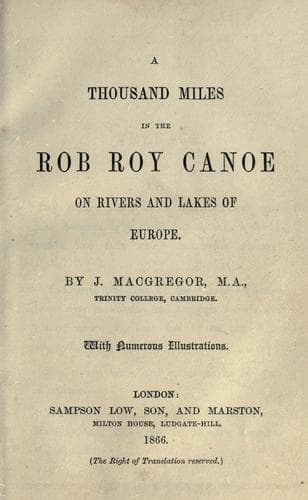
A Thousand Miles in the Rob Roy Canoe on Rivers and Lakes of EuropeMacGregor, John
History
A Thousand Miles in the Rob Roy Canoe on Rivers and Lakes of Europe
MacGregor, John
Canoes and canoeing -- Europe; Europe -- Description and travel; History -- Miscellanea; MacGregor, John, 1825-1892 -- Travel -- Europe
Long before I got to the word "slaves" the whole party were like
statues, silent and fixed in amazement. Then they looked right, left,
before, behind, and upwards in all directions, except, of course, into
the river, for why should they look _there_? nothing had ever come up
from the river to disturb their quiet mead. I next whistled a lively
air, and then dashing out of my hiding-place stood up in my boat, and
made a brief (but, we trust, brilliant) speech to them in the best
English I could muster, and in a moment afterwards we had vanished from
their sight.
A little further on there was some road-making in progress, and I pulled
up my boat under a tree and walked up to the "barraque," or workman's
canteen, and entered among 30 or 40 German "navvies," who were sitting
at their midday beer. I ordered a glass and drank their health standing,
paid, bowed, and departed, but a general rush ensued to see where on
earth this flannel-clad being had come from, and they stood on the bank
in a row as I waded, shoved, hauled, paddled, and carried my boat
through a troublesome labyrinth of channels and embankments, with which
their engineering had begun to spoil the river.
But the bridges one had now more frequently to meet were far worse
encroachments of civilization, for most of them were so low that my mast
would not pass under without heeling the boat over to one side, so as to
make the mast lean down obliquely. In one case of this kind she was very
nearly shipwrecked, for the wind was so good that I would not lower the
sail, and this and a swift current took us (me and my boat--she is now,
you see, installed as a "person") rapidly to the centre arch, when just
as we entered I noticed a fierce-looking snag with a sharp point exactly
in my course. To swerve to the side would be to strike the wooden pier,
but even this would be better (for I might ward off the violence of a
blow near my hands) than to run on the snag, which would be certain to
cut a hole.
With a heavy thump on the pier the canoe began to capsize, and only by
the nearest escape was she saved from foundering. What I thought was a
snag turned out to be the point of an iron stake or railing, carelessly
thrown into the water from the bridge above.
It may be here remarked that many hidden dangers occur near bridges, for
there are wooden or iron bars fixed under water, or rough sharp stones
lying about, which, being left there when the bridge was building, are
never removed from a river not navigable or used by boats.
Public-domain text, read in full here on John Shaqi.
Reviews
Reviews
No reviews yet
Be the first to share your thoughts on this work.
Join the Discussion
Join the discussion
Sign in to leave a comment or review.
Sign InorCreate an account