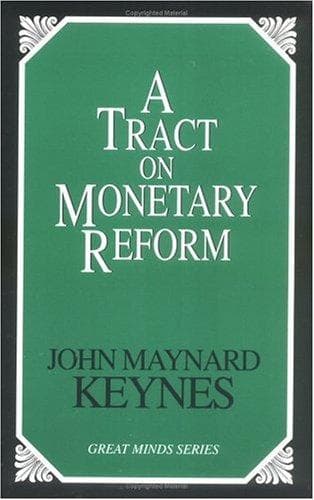
In pre-war days, when almost the whole world was on a gold standard,
we had all plumped for stability of exchange as against stability of
prices, and we were ready to submit to the social consequences of a
change of price level for causes quite outside our control, connected,
for example, with the discovery of new gold mines in foreign countries
or a change of banking policy abroad. But we submitted, partly because
we did not dare trust ourselves to a less automatic (though more
reasoned) policy, and partly because the price fluctuations experienced
were in fact moderate. Nevertheless, there were powerful advocates of
the other choice. In particular, the proposals of Professor Irving
Fisher for a Compensated Dollar, amounted, unless all countries adopted
the same plan, to putting into practice a preference for stability of
internal price level over stability of external exchange.
The right choice is not necessarily the same for all countries. It
must partly depend on the relative importance of foreign trade in the
economic life of the country. Nevertheless, there does seem to be in
almost every case a presumption in favour of the stability of prices,
if only it can be achieved. Stability of exchange is in the nature of
a convenience which adds to the efficiency and prosperity of those
who are engaged in foreign trade. Stability of prices, on the other
hand, is profoundly important for the avoidance of the various evils
described in Chapter I. Contracts and business expectations, which
presume a stable exchange, must be far fewer, even in a trading country
such as England, than those which presume a stable level of internal
prices. The main argument to the contrary seems to be that exchange
stability is an easier aim to attain, since it only requires that the
same standard of value should be adopted at home and abroad; whereas an
internal standard, so regulated as to maintain stability in an index
number of prices, is a difficult scientific innovation, never yet put
into practice.
Public-domain text, read in full here on John Shaqi.
Reviews
Reviews
No reviews yet
Be the first to share your thoughts on this work.
Elsewhere in the archive
Join the Discussion
Join the discussion
Sign in to leave a comment or review.
Sign InorCreate an account