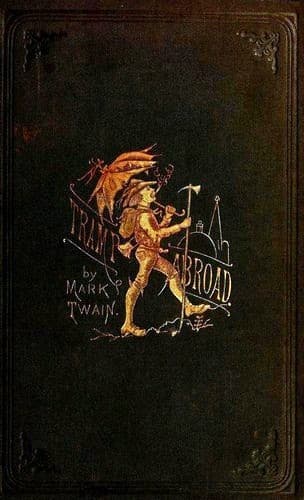
Americans -- Europe -- Fiction; Europe -- Fiction; Humorous stories; Walking -- Fiction
As we strolled along the road we looked up and saw a red signal-light
glowing in the darkness of the mountainside. It seemed but a trifling
way up--perhaps a hundred yards, a climb of ten minutes. It was a lucky
piece of sagacity in us that we concluded to stop a man whom we met and
get a light for our pipes from him instead of continuing the climb to
that lantern to get a light, as had been our purpose. The man said that
that lantern was on the Grands Mulets, some sixty-five hundred feet
above the valley! I know by our Riffelberg experience, that it would
have taken us a good part of a week to go up there. I would sooner not
smoke at all, than take all that trouble for a light.
Even in the daytime the foreshadowing effect of this mountain's close
proximity creates curious deceptions. For instance, one sees with the
naked eye a cabin up there beside the glacier, and a little above and
beyond he sees the spot where that red light was located; he thinks he
could throw a stone from the one place to the other. But he couldn't,
for the difference between the two altitudes is more than three thousand
feet. It looks impossible, from below, that this can be true, but it is
true, nevertheless.
While strolling around, we kept the run of the moon all the time, and we
still kept an eye on her after we got back to the hotel portico. I had
a theory that the gravitation of refraction, being subsidiary to
atmospheric compensation, the refrangibility of the earth's surface
would emphasize this effect in regions where great mountain ranges
occur, and possibly so even-handed impact the odic and idyllic forces
together, the one upon the other, as to prevent the moon from rising
higher than 12,200 feet above sea-level. This daring theory had been
received with frantic scorn by some of my fellow-scientists, and with
an eager silence by others. Among the former I may mention Prof. H----y;
and among the latter Prof. T----l. Such is professional jealousy; a
scientist will never show any kindness for a theory which he did not
start himself. There is no feeling of brotherhood among these people.
Indeed, they always resent it when I call them brother. To show how far
their ungenerosity can carry them, I will state that I offered to let
Prof. H----y publish my great theory as his own discovery; I even begged
him to do it; I even proposed to print it myself as his theory. Instead
of thanking me, he said that if I tried to fasten that theory on him he
would sue me for slander. I was going to offer it to Mr. Darwin, whom
I understood to be a man without prejudices, but it occurred to me
that perhaps he would not be interested in it since it did not concern
heraldry.
Public-domain text, read in full here on John Shaqi.
Reviews
Reviews
No reviews yet
Be the first to share your thoughts on this work.
Elsewhere in the archive
Join the Discussion
Join the discussion
Sign in to leave a comment or review.
Sign InorCreate an account