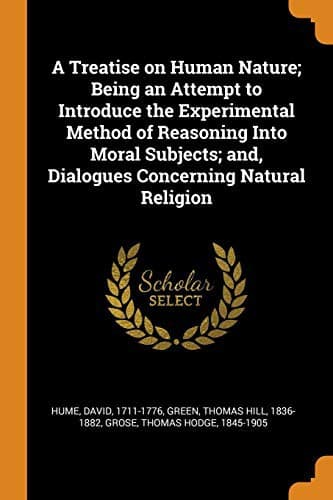
A Treatise of Human Nature: Being an Attempt to Introduce the Experimental Method Into Moral Subjects; and Dialogues Concerning Natural ReligionHume, David
PhilosophyPhilosophy
A Treatise of Human Nature: Being an Attempt to Introduce the Experimental Method Into Moral Subjects; and Dialogues Concerning Natural Religion
Hume, David
Emotions; Ethics; Knowledge, Theory of; Philosophy, English
119. The point of this, the most obvious, contradiction inherent
in Locke’s empiricism, is more or less striking according to the
fidelity with which the notion of matter-of-fact, or of the reality
that is not of the mind, proper to that system, is adhered to.
When the popular Logic derived from Locke has so far forgotten
the pit whence it was digged as to hold that propositions of a
certainty at once real and general can be derived from experience,
and to speak without question of ‘general matters-of-fact’ in a
sense which to Locke almost, to Hume altogether, would have been
a contradiction in terms, it naturally finds no disturbance in
regarding mathematical certainty as different not in kind, but only
in degree, from that of any other ‘generalisation from experience.’
Not aware that the distinction of mathematical from empirical
generality is the condition upon which, according to Locke, the
former escapes condemnation as ‘trifling,’ it does not see any need
for distinguishing the sources from which the two are derived, and
hence goes on asserting against imaginary or insignificant opponents
that mathematical truth is derived from ‘experience;’ which, if
‘experience’ be so changed from what Locke understood by it as to
yield general propositions concerning matters-of-fact of other than
analytical purport, no one need care to deny. That it can yield such
propositions is, doubtless, the supposition of the physical sciences;
nor, we must repeat, is it the _correctness_ of this supposition
that is in question, but the validity, upon its admission, of that
antithesis between experience and the work of thought, which is the
‘be-all and end-all’ of the popular Logic.
... and to received views of natural science: but Locke not so clear
about this.
Public-domain text, read in full here on John Shaqi.
Reviews
Reviews
No reviews yet
Be the first to share your thoughts on this work.
Elsewhere in the archive
Join the Discussion
Join the discussion
Sign in to leave a comment or review.
Sign InorCreate an account