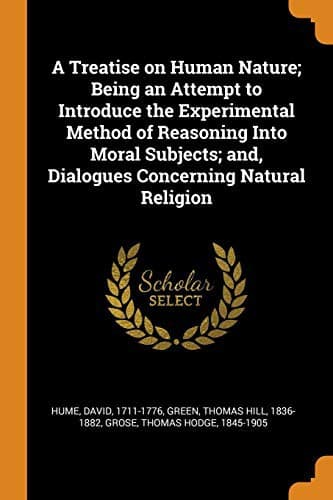
A Treatise of Human Nature: Being an Attempt to Introduce the Experimental Method Into Moral Subjects; and Dialogues Concerning Natural ReligionHume, David
PhilosophyPhilosophy
A Treatise of Human Nature: Being an Attempt to Introduce the Experimental Method Into Moral Subjects; and Dialogues Concerning Natural Religion
Hume, David
Emotions; Ethics; Knowledge, Theory of; Philosophy, English
127. The dominant notion of the self in Locke is that of the inward
substance, or ‘substratum of ideas,’ co-ordinate with the outward,
‘wherein they do subsist, and from which they do result.’ ‘Sensation
convinces that there are solid extended substances, and reflection
that there are thinking ones’ (Book II. chap, xxiii. sec. 29). We
have already seen how, without disturbance from his doctrine of the
fictitiousness of universals, he treats the simple idea as carrying
with it the distinction of outward and inward, or relations severally
to a ‘thing’ and to a ‘mind.’ It reports itself ambiguously as a
quality of each of these separate substances. It is now, or was to
begin with, the result of an outward thing ‘actually operating upon
us;’ for ‘of simple ideas the mind cannot make one to itself:’ on the
other hand, it is a ‘perception,’ and perception is an ‘operation
of the mind.’ In other words it is at once a modification of the
mind by something of which it is consciously not conscious, and a
modification of the mind by itself--the two sources of one and the
same modification being each determined only as the contradictory
of the other. Thus, when we come to probe the familiar metaphors
under which Locke describes Reflection, as a ‘fountain of ideas’
other than sensation, we find that the confusions which we have
already explored in dealing with the ideas of sensation recur under
added circumstances of embarrassment. Not only does the simple
idea of reflection, like that of sensation, turn out to be already
complicated in its simplicity with the superinduced ideas of cause
and relation, but the causal substance in question turns out to
be one which, from being actually nothing, becomes something by
acting upon itself; while all the time the result of this action is
indistinguishable from that ascribed to the opposite, the external,
cause.
Of which substance is perception the effect?
Public-domain text, read in full here on John Shaqi.
Reviews
Reviews
No reviews yet
Be the first to share your thoughts on this work.
Elsewhere in the archive
Join the Discussion
Join the discussion
Sign in to leave a comment or review.
Sign InorCreate an account