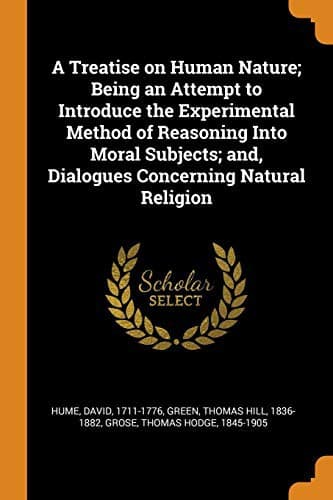
A Treatise of Human Nature: Being an Attempt to Introduce the Experimental Method Into Moral Subjects; and Dialogues Concerning Natural ReligionHume, David
PhilosophyPhilosophy
A Treatise of Human Nature: Being an Attempt to Introduce the Experimental Method Into Moral Subjects; and Dialogues Concerning Natural Religion
Hume, David
Emotions; Ethics; Knowledge, Theory of; Philosophy, English
140. Retaining Locke’s point of view, our answer of course must
be that our ideas of the Divine attributes, being primarily our
own ideas of reflection, are either ideas of the single successive
acts that constitute our inward experience or formed from these
by abstraction and combination. In parts our experience is given,
in parts only can we recall it. Our complex or abstract ideas are
symbols which only take a meaning so far as we resolve them into
the detached impressions which in the sum they represent, or recall
the objects, each with its own before and after, from which they
were originally taken. So it is with the ideas of wisdom, power, and
goodness, which from ourselves we transfer to God. They represent an
experience given in succession and piece-meal--a numerable series of
acts and events, which like every other number is already infinite
in the only sense of the word of which Locke can give a clear
account, as susceptible of indefinite repetition (Book II. chap.
vi. sec. 8.) When we ‘join infinity’ to these ideas, then, unless
some other meaning is given to infinity, we merely state explicitly
what was originally predicable of the experience they embody. Nor
will it avail us much to shift the meaning of infinite, as Locke
does when he applies it to the divine attributes, from that of
indefinite ‘addibility’ to that of exceeding any sum which indefinite
multiplication can yield us. Let us suppose an act of consciousness,
from which we have taken an abstract idea of an attribute--say of
wisdom--to be a million times repeated; our idea of the attribute
will not vary with the repetition. Nor if, having supposed a limit
to the repetition, we then suppose the act indefinitely repeated
beyond this limit and accordingly speak of the attribute as infinite,
will our idea of the attribute vary at all from what it was to
begin with. Its content will be the same. There will be nothing
to be said of it which could not have been said of the experience
from which it was originally abstracted, and of which the essential
characteristic--that it is one of a series of events of which no two
can be present together--is incompatible with divine perfection.
God only infinite in a sense in which time is _not_ infinite, and
which Locke could not recognize ...
Public-domain text, read in full here on John Shaqi.
Reviews
Reviews
No reviews yet
Be the first to share your thoughts on this work.
Elsewhere in the archive
Join the Discussion
Join the discussion
Sign in to leave a comment or review.
Sign InorCreate an account