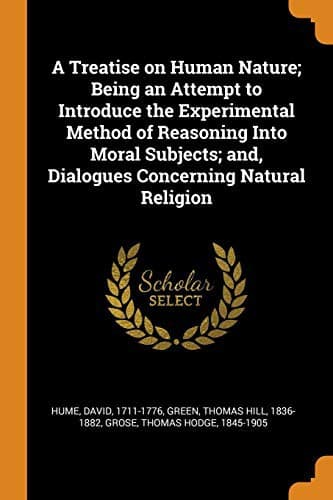
A Treatise of Human Nature: Being an Attempt to Introduce the Experimental Method Into Moral Subjects; and Dialogues Concerning Natural ReligionHume, David
PhilosophyPhilosophy
A Treatise of Human Nature: Being an Attempt to Introduce the Experimental Method Into Moral Subjects; and Dialogues Concerning Natural Religion
Hume, David
Emotions; Ethics; Knowledge, Theory of; Philosophy, English
142. A more positive answer it is not our present business to give.
Our concern is to show that ‘eternity and immensity,’ according to
any meaning that Locke recognises, or that the observation of our
ideas could justify, do not express any conception that can carry
us beyond the perpetual incompleteness of our experience; but that
in his doctrine of personal identity he does admit a conception
which no observation of our ideas of reflection--since these are
in succession and could not be observed if they were not--can
account for; and that it is just this conception, the conception of
a constant presence of consciousness to itself incompatible with
conditions of space and time, that can alone give such meaning to
‘eternal and infinite’ as can render them significant epithets of
God. Such a conception (we say it with respect) Locke admits when
it is wanted without knowing it. It must indeed always underlie
the idea of God, however alien to it may be attempted adaptations
of the other ‘infinite’--the _progressus ad indefinitum_ in space
and time--by which, as with Locke, the idea is explained. But it is
one for which the psychological method of observing what happens in
oneself cannot account, and which therefore this method, just so far
as it is thoroughly carried out, must tend to discard. That which
happens, whether we reckon it an inward or an outward, a physical or
a psychical event--and nothing but an event can, properly speaking,
be observed--is as such in time. But the presence of consciousness to
itself, though, as the true ‘punctum stans,’ [1] it is the condition
of the observation of events in time, is not such an event itself.
In the ordinary and proper sense of ‘fact,’ it is not a fact at all,
nor yet a possible abstraction from facts. To the method, then, which
deals with phrases about the mind by ascertaining the observable
‘mental phenomena’ which they represent, it must remain a mere
phrase, to be explained as the offspring of other phrases whose real
import has been misunderstood. It can only recover a significance
when this method, as with Hume, has done its worst, and is found to
leave the possibility of knowledge, without such ‘punctum stans,’
still unaccounted for.
[1] Locke, Essay II. chap. xvii. sec. 16.
How do I know my own real existence?--Locke’s answer.
Public-domain text, read in full here on John Shaqi.
Reviews
Reviews
No reviews yet
Be the first to share your thoughts on this work.
Elsewhere in the archive
Join the Discussion
Join the discussion
Sign in to leave a comment or review.
Sign InorCreate an account