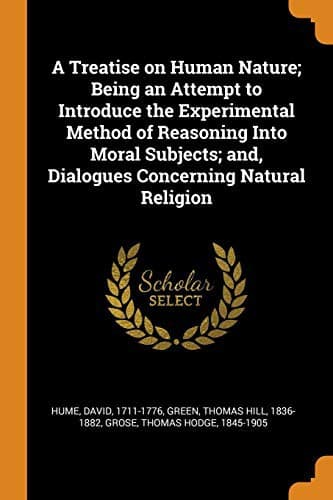
A Treatise of Human Nature: Being an Attempt to Introduce the Experimental Method Into Moral Subjects; and Dialogues Concerning Natural ReligionHume, David
PhilosophyPhilosophy
A Treatise of Human Nature: Being an Attempt to Introduce the Experimental Method Into Moral Subjects; and Dialogues Concerning Natural Religion
Hume, David
Emotions; Ethics; Knowledge, Theory of; Philosophy, English
145. We have already found that Locke accepts each of the above as
determinations of real existence, and that, though in spite of them
he labours to maintain the real existence of outward things, he is
so far faithful to them as to declare real essence unknowable. In
answering the question as to ‘his own existence’ he wholly ignores
them. He does not ask how the real existence of the thinking Ego
sorts with his ordinary doctrine that the real is what would be in
the world whether there were a mind or no; or its real identity,
present throughout the particulars of experience, with his ordinary
doctrine of the fictitiousness of ‘generals.’ A real existence of the
mind, however, founded on the logical necessity of substantiation,
rests on a shifting basis, so long as by the mind is understood a
thinking thing, different in each man, to which his inner experience
is referred as accidents to a substance. The same law of thought
which compels such reference requires that the thinking thing in
its turn, as that which is born grows and dies, be referred as an
accident to some ulterior substance. ‘A fever or fall may take away
my reason or memory, or both; and an apoplexy leave neither sense
nor understanding, no, nor life.’ [1] Just as each outer thing turns
out to be a ‘retainer to something else,’ so is it with the inner
thing. Such a dependent being cannot be an ultimate substance; nor
can any natural agents to which we may trace its dependence really
be so either. The logical necessity of further substantiation would
affect them equally, appearing in the supposition of an unknown
something beyond, which makes them what they are. It is under such
logical necessity that Locke, in regard to all the substances which
he commonly speaks of as ultimate--God, spirit, body--from time
to time gives warning of something still ulterior and unknowable,
whether under the designation of substance or real essence (Book II.
chap. xxiii. secs. 30 and 36). If, then, it will be said, substance
is but the constantly-shifting result of a necessity of thought--so
shifting that there is nothing of which we can finally say, ‘This
is substance, not accident’--there can be no evidence of the ‘real
existence’ of a permanent Ego in the necessary substantiation therein
of my inner experience.
[1] Locke, Book III. chap. vi. sec. 4.
Sense in which the self is truly real.
Public-domain text, read in full here on John Shaqi.
Reviews
Reviews
No reviews yet
Be the first to share your thoughts on this work.
Elsewhere in the archive
Join the Discussion
Join the discussion
Sign in to leave a comment or review.
Sign InorCreate an account