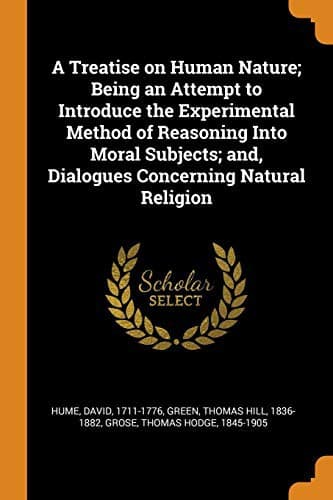
A Treatise of Human Nature: Being an Attempt to Introduce the Experimental Method Into Moral Subjects; and Dialogues Concerning Natural ReligionHume, David
PhilosophyPhilosophy
A Treatise of Human Nature: Being an Attempt to Introduce the Experimental Method Into Moral Subjects; and Dialogues Concerning Natural Religion
Hume, David
Emotions; Ethics; Knowledge, Theory of; Philosophy, English
152. As we have seen, neither of these alternative views is really
met by Locke. To the former we may reply that the relation between
two events, of which neither has anything in common with the other,
but which we improperly speak of as effect and cause (_e.g._ death
and a sunstroke), has no likeness to that which we have explained
between the world in its contingency and the world as an eternal
system--a relation according to which the cause is the effect in
unity. Whatever is part of the reality of the world must belong, it
would seem, to the ‘ens realissimum,’ its cause. We are thus thrown
back on the other horn of the dilemma. Is not matter part of the
reality of the world? This is a question to which the method of
observing the individual consciousness can give none but a delusive
answer. A true answer cannot be given till for this method has been
substituted the enquiry, How knowledge is possible, and it has been
found that it is only possible as the progressive actualisation in
us of a self-consciousness in itself complete, and which in its
completeness includes the world as its object. From the point of view
thus attained the question as to matter will be, How is it related to
this self-consciousness?--a question to which the answer must vary
according to what is understood by ‘matter.’ If it means the abstract
opposite of thought--that which is supposed void of all determination
that comes of thinking--we must pronounce it simply a delusion, the
creation of self-consciousness in one stage of its communication to
us. If it means the world as in space and time, this we may allow to
be real enough as a stage in the process by which self-consciousness
constitutes reality. Thus understood, we may speak of it roughly as
part of the ‘ens realissimum’ which the complete self-consciousness,
or God, includes as its object, without any limitation of the divine
perfectness. The limitation only seems to arise so far as we, being
ourselves (as our knowledge and morality testify), though formally
self-conscious, yet parts of this partial world, interpret it amiss
and ascribe to it a reality, in abstraction from the self-conscious
subject, which it only derives from relation to it. Thus while on
the one hand it is the presence in us of God, as the self-conscious
source of reality, that at once gives us the idea of God and of an
eternal self, and renders superfluous the further question as to
their real existence; on the other hand it is because, for all this
presence, we are but emerging from nature, of which as animals we are
parts, that to us there must seem an incompatibility of existence
between God and matter, between the self and the flux of events which
makes our life. This necessary illusion is our bondage, but when the
source of illusion is known, the bondage is already being broken.
Locke’s antinomies--Hume takes one side of them as true.
Public-domain text, read in full here on John Shaqi.
Reviews
Reviews
No reviews yet
Be the first to share your thoughts on this work.
Elsewhere in the archive
Join the Discussion
Join the discussion
Sign in to leave a comment or review.
Sign InorCreate an account