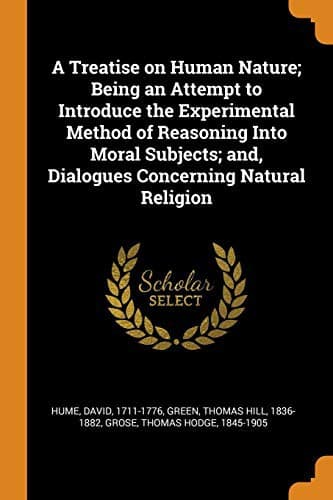
A Treatise of Human Nature: Being an Attempt to Introduce the Experimental Method Into Moral Subjects; and Dialogues Concerning Natural ReligionHume, David
PhilosophyPhilosophy
A Treatise of Human Nature: Being an Attempt to Introduce the Experimental Method Into Moral Subjects; and Dialogues Concerning Natural Religion
Hume, David
Emotions; Ethics; Knowledge, Theory of; Philosophy, English
154. Such a doctrine--a doctrine founded on the testimony of
the senses, which ends by showing that the senses testify to
nothing--cannot be criticised step by step according to the order in
which its author puts it, for its characteristic is that, in order
to state itself, it has to take for granted popular notions which it
afterwards shows to be unmeaning. Its power over ordinary thinkers
lies just in this, that it arrives at its destructive result by
means of propositions which every one believes, but to the validity
of which its result is really fatal. An account of our primitive
consciousness, which derives its plausibility from availing itself of
the conceptions of cause and substance, is the basis of the argument
which reduces these conceptions to words misunderstood. It cannot,
therefore, be treated by itself, as it stands in the first part of
the Treatise on the Understanding, but must be taken in connection
with Part IV., especially with the section on ‘Scepticism with regard
to the Senses;’ not upon the plan of discrediting a principle by
reference to the ‘dangerous’ nature of its consequences, but because
the final doctrine brings out the inconsistencies lurking in that
assumed to begin with. On this side of his scepticism Hume mainly
followed the orthodox Berkeley, of whose criticism of Locke, made
with a very different purpose, some account must first be given.
The connection between the two authors is instructive in many ways;
not least as showing that when the most pious theological purpose
expresses itself in a doctrine resting on an inadequate philosophical
principle, it is the principle and not the purpose that will regulate
the permanent effect of the doctrine.
Berkeley’s religious interest in making Locke consistent.
Public-domain text, read in full here on John Shaqi.
Reviews
Reviews
No reviews yet
Be the first to share your thoughts on this work.
Elsewhere in the archive
Join the Discussion
Join the discussion
Sign in to leave a comment or review.
Sign InorCreate an account