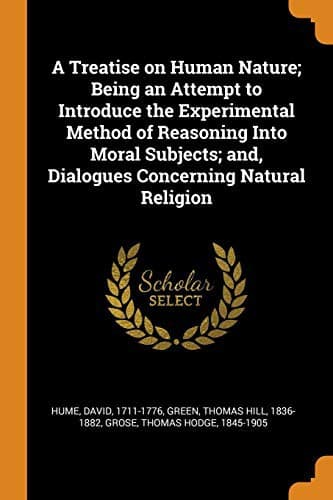
A Treatise of Human Nature: Being an Attempt to Introduce the Experimental Method Into Moral Subjects; and Dialogues Concerning Natural ReligionHume, David
PhilosophyPhilosophy
A Treatise of Human Nature: Being an Attempt to Introduce the Experimental Method Into Moral Subjects; and Dialogues Concerning Natural Religion
Hume, David
Emotions; Ethics; Knowledge, Theory of; Philosophy, English
singular proposition stated a sensible event or the occurrence of a
feeling, such substitution would be inexplicable: for if that were
the true account of the singular proposition, a general one could but
express such expectation of the recurrence of the event as repeated
experience of it can alone give. But a relation is not contingent
with the contingency of feeling. It is permanent with the permanence
of the combining and comparing thought which alone constitutes it;
and for that reason, whether it be recognised as the result of a
mathematical construction or of a crucial experiment in physics, the
proposition which states it must already be virtually universal.
Traces of progress in his idealism.
185. Of such a doctrine Berkeley is rather the unconscious forerunner
than the intelligent prophet. It is precisely upon the question
whether, or how far, he recognised the constitution of things by
intelligible relations, that the interpretation of his early (which
is his only developed) idealism rests. Is it such idealism as Hume’s,
or such idealism as that adumbrated in some passages of his own
‘Siris’? Is the idea, which is real, according to him a feeling or
a conception? Has it a nature of its own, consisting simply in its
being felt, and which we afterwards for purposes of our own consider
in various relations; or does the nature consist only in relations,
which again imply the action of a mind that is eternal--present
to that which is in succession, but not in succession itself? The
truth seems to be that this question in its full significance never
presented itself to Berkeley, at least during the period represented
by his philosophical treatises. His early idealism, as we learn
from the commonplace-book brought to light by Professor Fraser, was
merely a cruder form of Hume’s. By the time of the publication of
the ‘Principles of Human Knowledge’ he had learnt that, unless this
doctrine was to efface ‘spirit’ as well as ‘matter,’ he must modify
it by the admission of a ‘thing’ that was not an ‘idea,’ and of which
the ‘esse’ was ‘percipere’ not ‘percipi.’ This admission carried with
it the distinction between the object felt and the object known,
between ‘idea’ and ‘notion’--a distinction which was more clearly
marked in the ‘Dialogues.’ Of ‘spirit’ we could have a ‘notion,’
though not an ‘idea.’ But it was only in the second edition of the
‘Principles’ that ‘relation’ was put along with ‘spirit,’ as that
which could be known but which was no ‘idea:’ and then without any
recognition of the fact that the whole reduction of primary qualities
to mere ideas was thereby invalidated. The objects, with which the
mathematician deals, are throughout treated as in their own nature
‘particular ideas,’ into the constitution of which relation does not
enter at all; in other words, as successive feelings.
His way of dealing with physical truths.
Public-domain text, read in full here on John Shaqi.
Reviews
Reviews
No reviews yet
Be the first to share your thoughts on this work.
Elsewhere in the archive
Join the Discussion
Join the discussion
Sign in to leave a comment or review.
Sign InorCreate an account